Letters from Australia Series: Letter 1
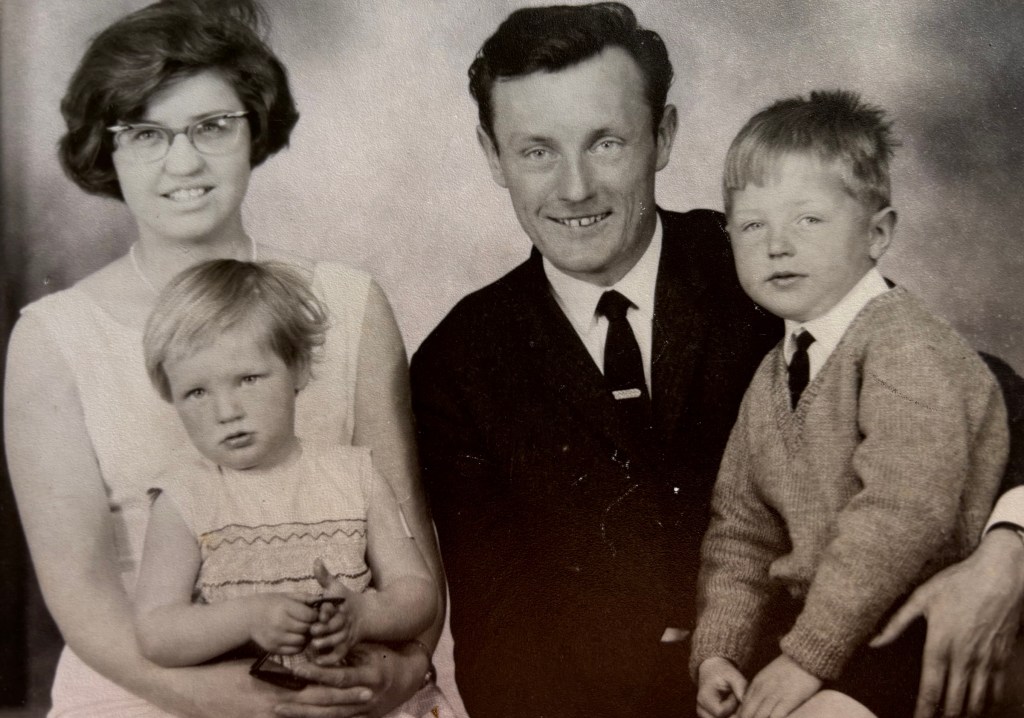
Our Family’s Big Move
The 22nd of August 1966 plays a pivotal role in the story of our family. It was on this day, sixty years ago, that we arrived in our new home — Perth, Western Australia.
My parents, Keith and Christine Lucas, had earlier made a big life decision. Like so many others who took advantage of the Australian Government’s Assisted Passage Scheme, they uprooted their family’s life in the north of England and embarked on a journey to the other side of the world. I was just two years old, and my brother was four.
Mum, an avid writer, decided to document our journey and our early life in our new home through a series of letters published in the Runcorn Weekly News, a newspaper in her hometown of Runcorn, Cheshire.
In honour of our milestone anniversary, I have decided to publish Mum’s articles in full over the coming weeks so you can see what life was like for us, our fellow “Ten Pound Poms” and, of course, the locals who had always called the place home. Her letters covered employment, housing, health, education, social life, family life and more.
I hope, like me, you find it interesting to read a contemporary take on life in Australia. It isn’t a reflection or a memoir. It is life as it happened.
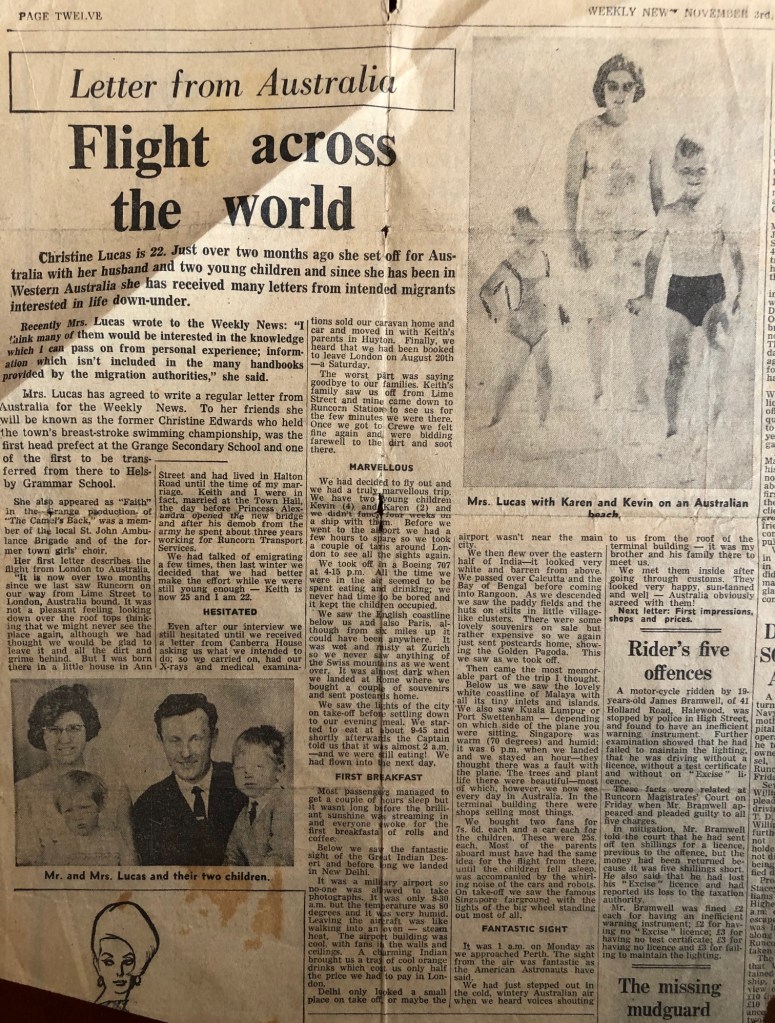
The first article, published on 3rd November 1966, introduces our family and looks at our journey.
A note about the transcription: Mum’s article has been reproduced as it appeared in the Runcorn Weekly News. I have retained the original wording, place names, currency and expressions of the time. Some brief explanations appear after the article.
The article reads…
Christine Lucas is 22. Just over two months ago she set off for Australia with her husband and two young children and since she has been in Western Australia she has received many letters from intended migrants interested in life down-under.
Recently Mrs. Lucas wrote to the Weekly News: “I think many of them would be interested in the knowledge which I can pass on from personal experience; information which isn’t included in the many handbooks provided by the migration authorities,” she said.
Mrs. Lucas has agreed to write a regular letter from Australia for the Weekly News. To her friends she will be known as the former Christine Edwards who held the town’s breast-stroke swimming championship, was the first head prefect at the Grange Secondary School and one of the first to be transferred from there to Helsby Grammar School.
She also appeared as “Faith” in the Grange production of “The Camel’s Back,” was a member of the local St. John Ambulance Brigade and of the former town girls’ choir.
Her first letter describes the flight from London to Australia.
“It is now over two months since we last saw Runcorn on our way from Lime Street to London, Australia bound. It was not a pleasant feeling looking down over the roofs, thinking that we might never see the place again, although we had thought we would be glad to leave it and all the dirt and grime behind. But I was born there in a little house in Ann Street and had lived in Halton Road until the time of my marriage.
Keith and I were in fact married at the Town Hall, the day before Princess Alexandra opened the new bridge and after his demob from the army he spent about three years working for Runcorn Transport Services.
We had talked of emigrating for a few months, then last winter decided that we had better make the effort while we were still young enough. Keith is now 25 and I am 22.
Hesitated
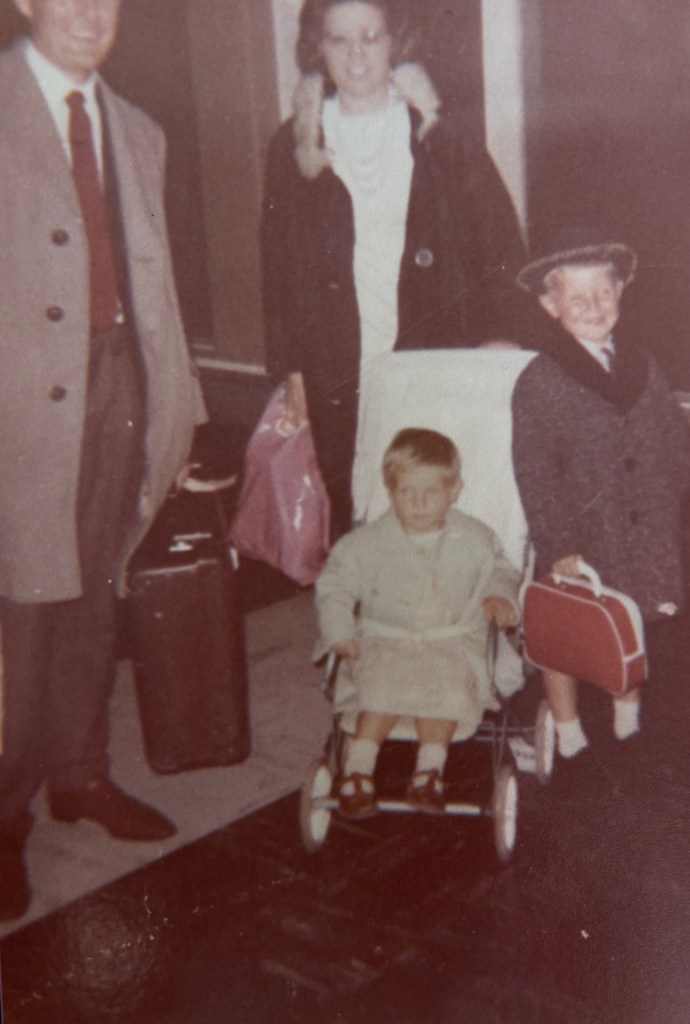
Even after our interview we still hesitated until we received a letter from Canberra House asking us what we intended to do. So we carried on, had our X-rays and medical examinations, sold our caravan home and car and moved in with Keith’s parents in Huyton. Finally, we had been booked to leave London on August 20th, a Saturday.
The worst part was saying goodbye to our families. Keith’s family saw us off from Lime Street and mine came down to Runcorn Station to see us for the few minutes we were there. Once we got to Crewe we felt fine again and were bidding farewell to the dirt and soot there.
Marvellous
We had decided to fly out and we had a truly marvellous trip. We have two young children, Kevin (4) and Karen (2), and we didn’t fancy four weeks on a ship with them. Before we left we had a few hours to spare so we took a couple of taxis around London to see all the sights again.
We took off in a Boeing 707 at 4.15 p.m. All the time we were in the air seemed to be spent eating and drinking; we never had time to be bored and it kept the children occupied.
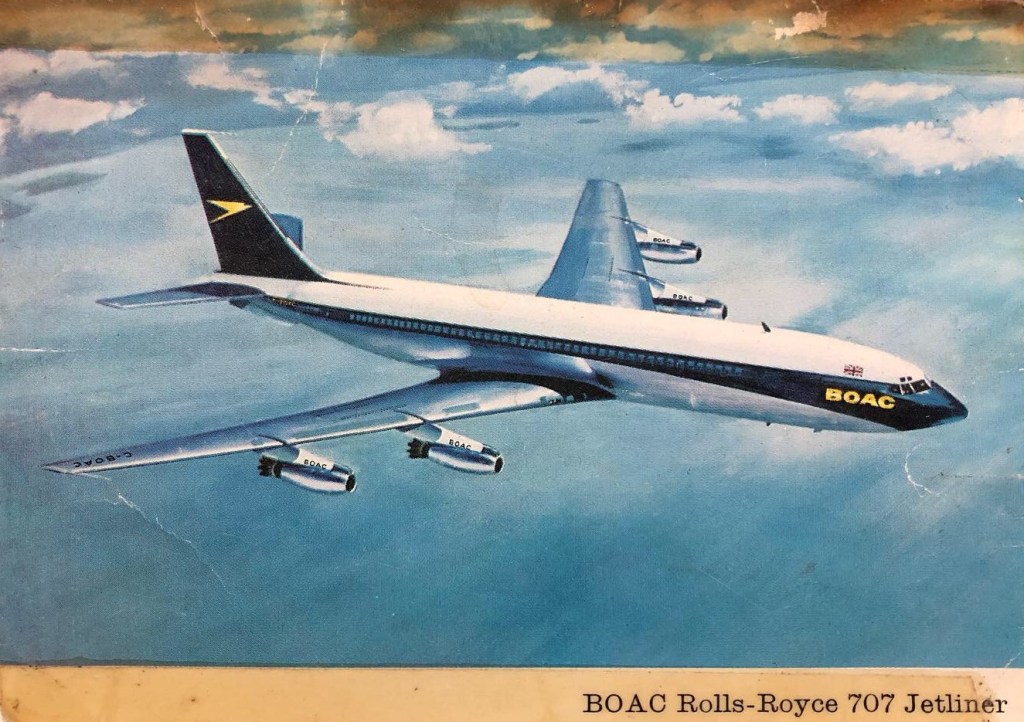
We saw the English coastline below us and also Paris, although from six miles up it could have been anywhere. It was wet and misty at Zurich so we never saw anything of the Swiss mountains as we went over. It was almost dark when we landed at Rome where we bought a couple of souvenirs and sent postcards home.
We saw the lights of the city on take-off before settling down to our evening meal. We started to eat at about 9.45 and shortly afterwards the Captain told us that it was almost 2.00 a.m. and we were still eating! We had flown into the next day.
First Breakfast
Most passengers managed to get a couple of hours sleep but it wasn’t long before the brilliant sunshine was streaming in and everyone woke for the first breakfast of rolls and coffee.
Below we saw the fantastic sight of the Great Indian Desert and before long we landed in New Delhi.
It was a military airport so no-one was allowed to take photographs. It was only 8.30 a.m. but the temperature was 80 degrees and it was very humid. Leaving the aircraft was like walking into an oven — steam and heat. The airport building was cool, with fans in the walls and ceilings. A charming Indian brought us a tray of cool orange drinks which cost us only half the price we had to pay in London.
Delhi only looked a small place on take-off or maybe the airport wasn’t near the main city. We then flew over the eastern half of India — it looked very white and barren from above. We passed over Calcutta and the Bay of Bengal before coming into Rangoon. As we descended we saw the paddy fields and huts on stilts in little villages like clusters. There were some lovely souvenirs on sale but rather expensive so we again just sent postcards home, showing the Golden Pagoda. This was what we saw as we took off.
Then came the most memorable part of the trip I thought.
Below us we saw the lovely white coastline of Malaya with all its tiny inlets and islands. We also saw Kuala Lumpur or Port Swettenham — depending on which side of the plane you were sitting. Singapore was warm (70 degrees) and humid; it was 6.00 p.m. when we landed and we stayed an hour — they thought there was a fault with the plane. The trees and plant life there were beautiful — most of which, however, we now see every day in Australia. In the terminal building there were shops selling most things.
We bought two fans for 7s. 6d. each and a car each for the children. These were 25s. each. Most of the parents aboard must have had the same idea for the flight from there until the children fell asleep, was accompanied by the whirring noise of the cars and robots. On take off we saw the famous Singapore fairground with the lights of the big wheel standing out most of all.
Fantastic Sight
It was 1.00 a.m. on Monday as we approached Perth. The sight from the air was fantastic as the American Astronauts have said.
We had just stepped out into the cold, wintry Australian air when we heard voices shouting to us from the roof of the terminal building — it was my brother and his family there to meet us.
We met them inside after going through customs. They looked very happy, sun-tanned and well — Australia obviously agreed with them!”
Next letter: First impressions, shops and prices.
My Notes: 60 Years On
The Ten Pound Pom scheme
We came to Australia under the Australian Government’s Assisted Passage Migration Scheme. By the 1960s, each adult paid £10 sterling towards the journey, while children travelled free. For our family, Mum and Dad’s fares therefore cost a total of £20. The scheme brought more than a million British migrants to Australia between the late 1940s and early 1970s.
The National Museum of Australia’s history of the postwar immigration drive provides an excellent introduction to the scheme. The National Archives of Australia also holds original promotional material describing the assisted fares.
Pounds, shillings and pence
Britain still used pounds, shillings and pence in 1966, while Australia had introduced decimal currency on 14 February that year. At the fixed exchange rate then operating, £1 sterling was worth approximately A$2.50. The two fans Mum and Dad bought for 7s. 6d. each therefore cost about 94 Australian cents each, while the toy cars costing 25s. each were approximately A$3.13 each. Mum and Dad’s two £10 assisted fares were equivalent to approximately A$50 in total. These are direct 1966 currency conversions, not their equivalent purchasing power today.
Australia’s own pre-decimal pound converted at a different rate — £A1 became A$2 — but the amounts Mum quoted were British sterling. The historical exchange relationship recorded by the Australian Bureau of Statistics confirms that £125 Australian equalled £100 sterling in 1966.
Changing place names
Several of the names Mum used have since changed:
- Calcutta was officially renamed Kolkata in 2001.
- Rangoon was officially renamed Yangon in 1989.
- Port Swettenham was renamed Port Klang in 1972.
- “Malaya” requires a little qualification. Malaysia had already been formed in 1963, three years before our journey. Mum was using the older and still-familiar name for the Malay Peninsula, now generally called Peninsular Malaysia.
Perth Airport
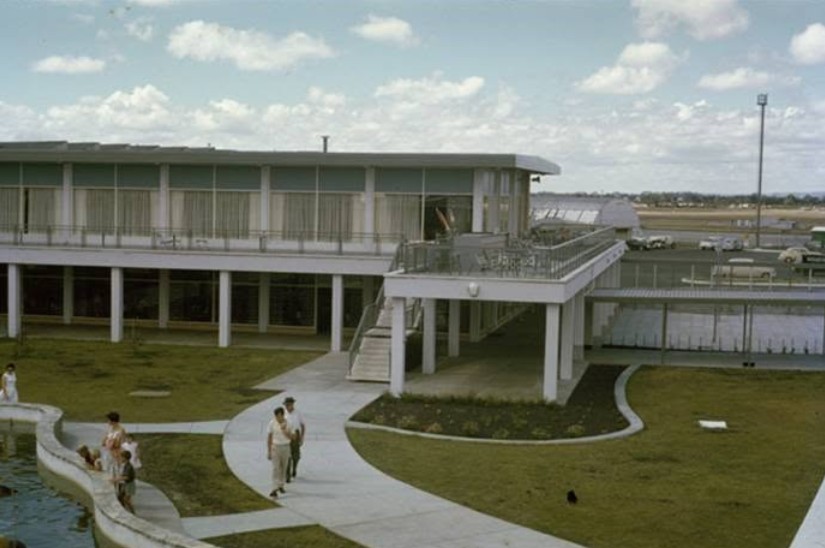
For anyone unfamiliar with the old Perth Airport, Mum’s words — “we heard voices shouting to us from the roof of the terminal building”— may create a rather confusing image. There was an observation deck on the roof from which visitors could watch the activity on the tarmac. My uncle, aunt and cousins weren’t on the roof of the airport building.
My Final Thoughts
Sixty years later, I can only imagine what Mum and Dad must have felt as that Boeing 707 approached Perth in the early hours of that 1966 morning. They were twenty-two and twenty-five, with two small children, leaving almost everything familiar behind, including their parents, most of their siblings and all of their friends. They could not have known then how that decision would shape our lives and those of the generations that followed.
I love visiting the UK, but I’m so glad that they brought me here. I have had many wonderful opportunities that I’m sure would never have come my way had I grown up in the north of England. In fact, when I visited Liverpool for the first time as an adult in 1990, I wrote to Mum and Dad in Australia and thanked them for taking me to Australia.
Australia is home.


 Your Family Stories
Leave a comment