Letters from Australia Series: Letter 4
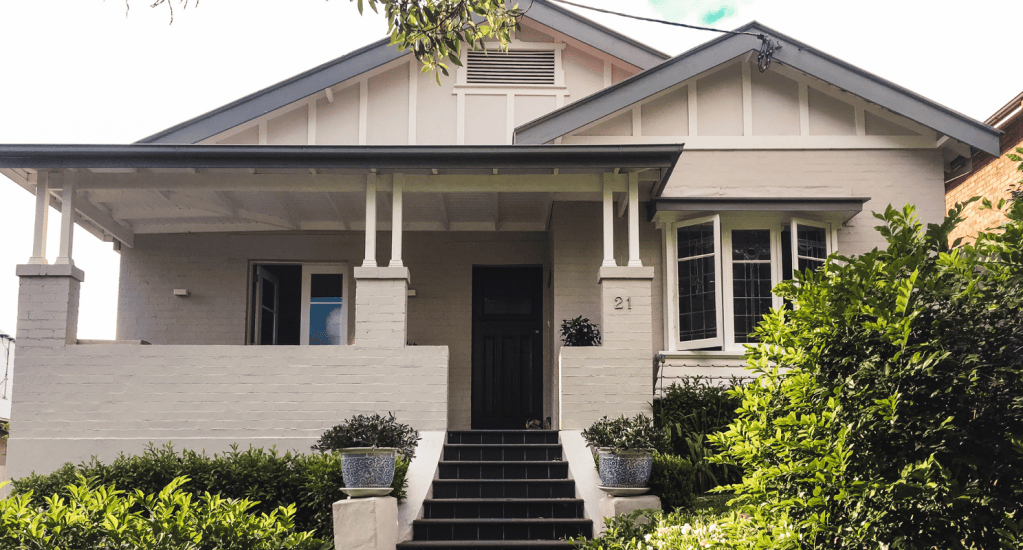
Housing for New Migrants
The fourth article in the Letters from Australia series was published in the Runcorn Weekly News on 24 November 1966. By this stage we’d been in Australia for three months and Mum’s letter about housing, whether it be to rent or buy, was very insightful. She also looked at what was needed to furnish your new home.
The headline – Housing can be a problem – could be used even today, sixty years later. In fact, it seems lately that the word ‘housing’ can’t appear in the Australian press without being followed by the word ‘crisis’.
The newspaper article reads …
An insight into housing opportunities in Australia is given by former Runcornian, Mrs Christine Lucas, now living in Australia, in her fourth letter.
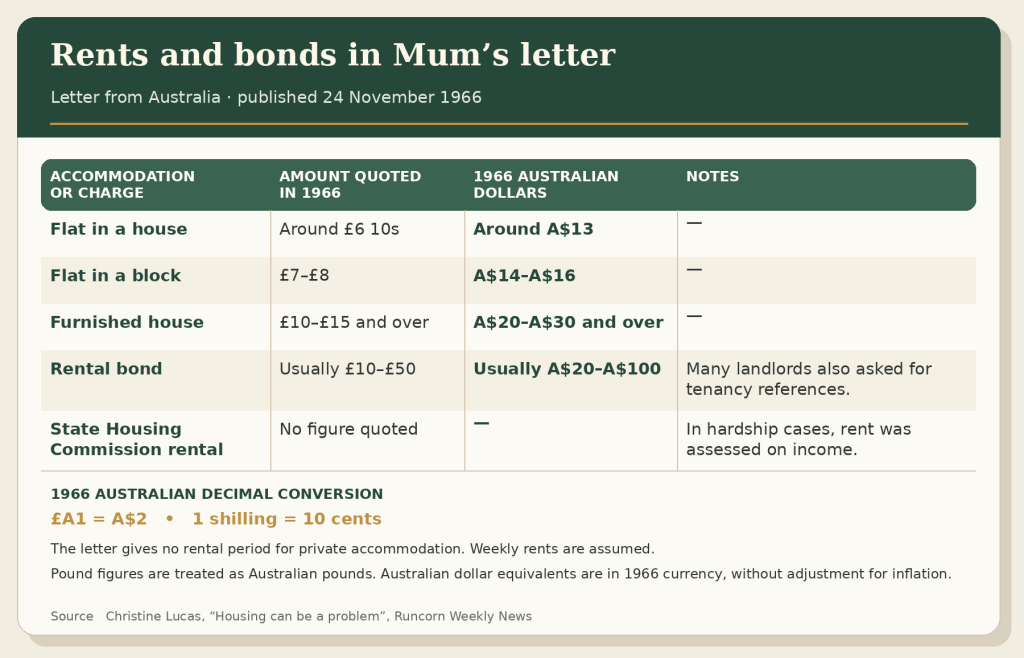
“The migration officer at the interview lets you know that there is no difficulty in obtaining rented accommodation. What they don’t tell you is that rents charged for a flat are high by comparison to English rents. A flat in a house costs around £6 10s; in a block they are £7 to £8 and furnished houses can be rented from £10 to £15 and over.
Many prospective landlords require bonds, usually a payment of £10 to £50, and often they want to see tenancy references. It is fairly difficult to get accommodation if you have young children. Anyone really trying could get fixed up but it requires a lot of looking.
Housing language also differs: A house here is what we call in England a bungalow, homes with an upstairs are known as two-storey houses, a block of flats is a ‘multiplex’ and a semi-detached is a ‘duplex’. Each flat in a block is called a ‘home unit’.
A house can be obtained for a deposit of £200 – £250 through a scheme controlled by the State Housing Commission. The waiting period varies depending on the area chosen for the home.
When your turn comes, you are then invited to go and choose the house design you like. These houses have two or three bedrooms and a bathroom with a shower. All new houses have a laundry, a small room with a stainless steel sink, space for a washing machine and a power point. The back door into the garden usually leads from this room.
State houses can also be rented but the waiting period is longer and in cases of hardship the rents are assessed on income.
Buying privately, asbestos and tin homes, or wooden ones can be bought for a £400 – £500 deposit but these tend to be older houses as brick and tile are extensively used now.
Some housing companies have schemes for sponsoring migrants, who have £1,000 Sterling, to come out with the view of buying one of the companies’ houses. They provide a flat while you find employment and decide about a house.
This is a good scheme as houses vary in style and price on all estates. Estates are well planned with plenty of space between houses. The roads are built first and one company lays the lawns and plants the shrubs and trees in the gardens and even puts curtains up in the windows. The houses are thus ready to move into without all the worry of having to do the outside.
Another way to get a house is to buy the land first then choose the design of the house and the company you wish to build it. Providing the land is paid for the house can then be built at no further deposit. Anyone coming to Australia with a small capital would find that they could get well planned houses quite easily.
Scandinavian made furniture is probably the best but is rather expensive. Some Australian furniture is good but this too tends to be expensive. Cheap modern styled furniture is available but it is poorly finished. Anyone with good English furniture is advised to bring it with them.
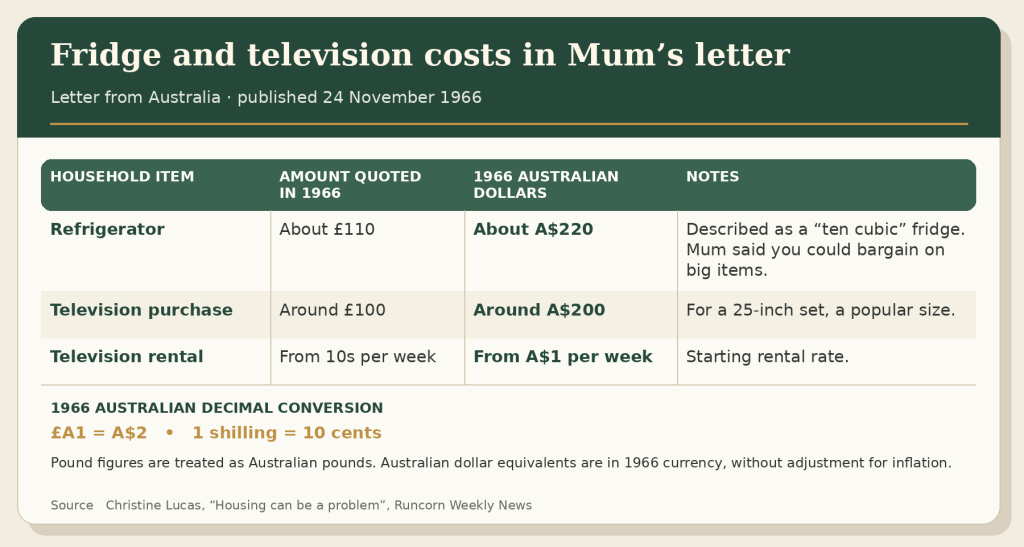
Refrigerators are well designed, incorporating all the latest ideas, and can be bought in any size. A ten cubic fridge costs about £110 but bargaining goes on a lot and if you’re good at it you can usually get a few pounds knocked off big items.
There is more trade in second-hand goods, a fair price being offered when you trade in your old goods for the latest models. This makes second-hand goods expensive and keeps up the price of new items.
Televisions still tend to be expensive but designs are modern. Although there are still quite a lot of the old type around, a popular size is 25 inch and these cost around £100. Televisions can also be rented from ten shillings a week.
Television is fairly new here having just celebrated its seventh year. There are three channels, including two commercial, and programmes start at midday often with a feature film. Radio has seven stations mostly beating out popular music and advertisements.”
My Thoughts: 60 Years On
Buying or Renting Today
Housing is expensive and for many families consumes a great percentage of their income.
According to the Real Estate Institute of Western Australia (REIWA), the median Perth house price for the 12 months to October 2026 is $965,000. Of course, that means there are cheaper homes in some areas but there are now many suburbs where the median house price exceeds $1 million, and plenty of suburbs where you are looking at a multi-million-dollar price tag.
The median rent in the Perth metro area is now $750 per week for a house and $700 for a unit (flat, apartment, townhouse, villa). The 2026 Rental Affordability Index ranked Perth as Australia’s least affordable capital city for renters for the third year running.
Most people rent or buy in the private market. The state government no longer develops estates on the scale it once did. That said, the current government seems to be working overtime to increase public housing stock.
Number of bedrooms
Mum wrote that the State Housing Commission homes had two or three bedrooms. According to the Australian Bureau of Statistics, in the 2021 Census, almost half of Greater Perth’s occupied private dwellings had four bedrooms or more.
It was very normal for siblings to share bedrooms when I was growing up. For many years there were seven of us living in a three-bedroom, one-bathroom house. I often wonder how we managed!
Mum and Dad in real estate
Mum and Dad always had an interest in houses. They bought and sold plenty over the years as they moved around the country (they lived in Western Australia, Tasmania and Queensland).
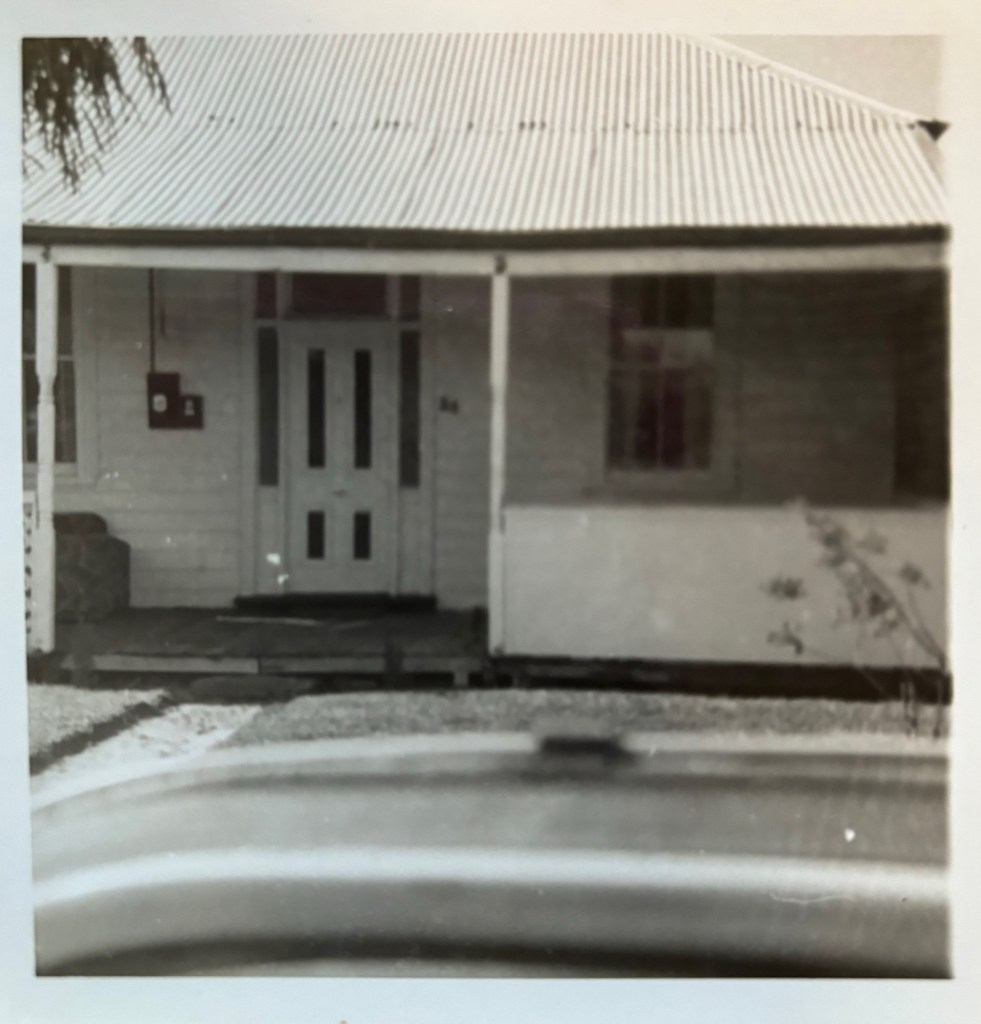
In the 1980s, they ventured into roles as real estate agents for a while, selling houses for others. I guess that’s why I came across this photo in the family album. This was the house that my grandparents rented for a few years in the late 1960s and possibly the early 1970s. Mum noted that this property sold for $205,000 in 1989.
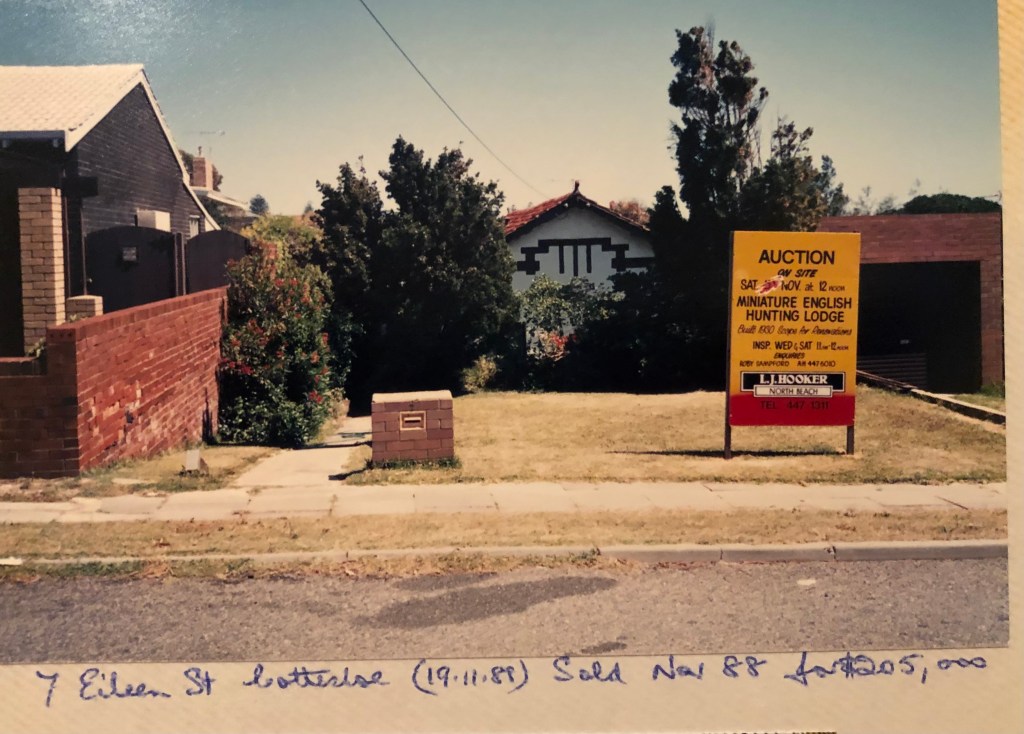
This house was demolished years ago and the block subdivided. The two properties subsequently built there now have estimated values of more than $2.5 million each, according to real estate websites. Still, if you walk about 120 metres from the front door, you can dip your toes in the Indian Ocean.
Furniture and Electrical Goods
When you think of Scandinavian furniture today, one word springs to mind – IKEA! I found it interesting that Scandinavian furniture was also big in the 1960s.
The prices for refrigerators and televisions seem so high when compared to the wages people were earning at the time. Many of those appliances were built to last, and changes in technology often gave people a reason to upgrade.
A fridge of that size (10 cubic feet, or about 283 litres) would cost about $600–$800 today.
Some TVs today are like cinema screens on the wall, but you can still buy a ‘small’ 32-inch TV new for $200–$500. In fact, I recently saw a Black Friday sale advertisement with a 32-inch TV for only $99!
In 1966, at the men’s state basic wage of A$33.50 a week (see Letter 3), a fridge cost more than six and a half weeks’ wages and a TV cost nearly six weeks’ wages. Today the national adult minimum wage is $1,004.90 per week, meaning these goods are far more affordable.
Do you remember the television test pattern?
It was on the screens when there was no programming. I sometimes wonder how many people still watch free-to-air TV. With streaming services, you can watch just about anything you like, whenever you like.
I still love Cottesloe
I have very fond memories of the years we lived in Cottesloe. And whenever I think of Nana and Grandad’s rented house in Eileen Street, I remember getting together with all the aunties, uncles and cousins, and walking down to the beach for a swim or to buy some fish and chips for tea.
Mum was writing this article for people wondering how they’d find somewhere to live when they got here. Sixty years on, I can see what finding a place meant for our family. So many of my happy memories of those early years begin in Cottesloe.
Notes for the Letters from Australia series:
The Ten Pound Pom scheme
We came to Australia under the Australian Government’s Assisted Passage Migration Scheme. By the 1960s, each adult paid £10 sterling towards the journey, while children travelled free. For our family, Mum and Dad’s fares therefore cost a total of £20. The scheme brought more than a million British migrants to Australia between the late 1940s and early 1970s.
The National Museum of Australia’s history of the postwar immigration drive provides an excellent introduction to the scheme. The National Archives of Australia also holds original promotional material describing the assisted fares.
Pounds, shillings and pence
Australia introduced decimal currency in February 1966. For the tables in this article, I’ve treated the unmarked pound amounts as Australian pounds, at £A1 = A$2. Mum specified that the £1,000 required by some migrant sponsorship schemes was in sterling, equivalent to about A$2,500 at the time. The Australian Bureau of Statistics explains the historical relationship between the two currencies.
Coming soon: Letter 5: On the beach – at 94 degrees. Mum says that “the beaches are everything they are said to be in the migrant literature”. Find out how we entertained ourselves outdoors as Mum writes about swimming, surfing, fishing, boating and more.
See also:
Letter 1: Flight Across the World


Leave a Reply