Letters from Australia Series: Letter 3
Employment for New Migrants
The third article in the Letters from Australia series was published in the Runcorn Weekly News on 17 November 1966. Written just a few months into our new life in Perth, Western Australia, Mum’s focus this time was on employment opportunities for new migrants.
As I sit at my computer, able to research almost anything with a few keystrokes from the comfort of home, I marvel at Mum’s efforts to gather information. She was a busy 22-year-old wife and mother, living on the other side of the world, investigating so many aspects of everyday life and writing a detailed series for people contemplating making Australia their home.
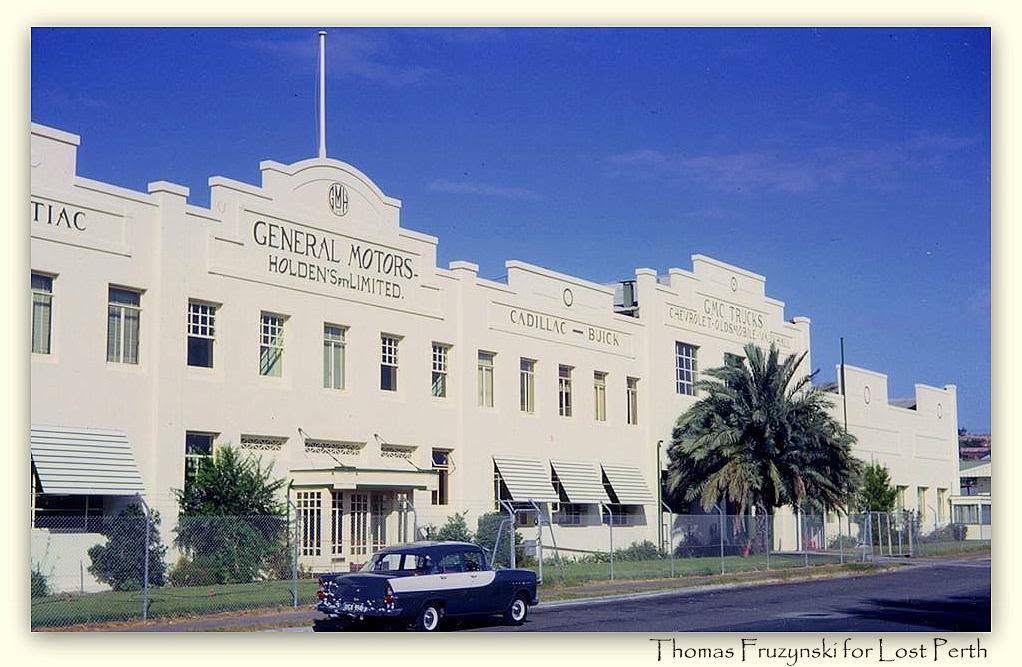
The photograph above shows the General Motors-Holden’s factory in Mosman Park, where my grandad worked after he followed us to Australia. I thought it was a particularly fitting image for this article, given Mum’s observations about working conditions in the motor industry.
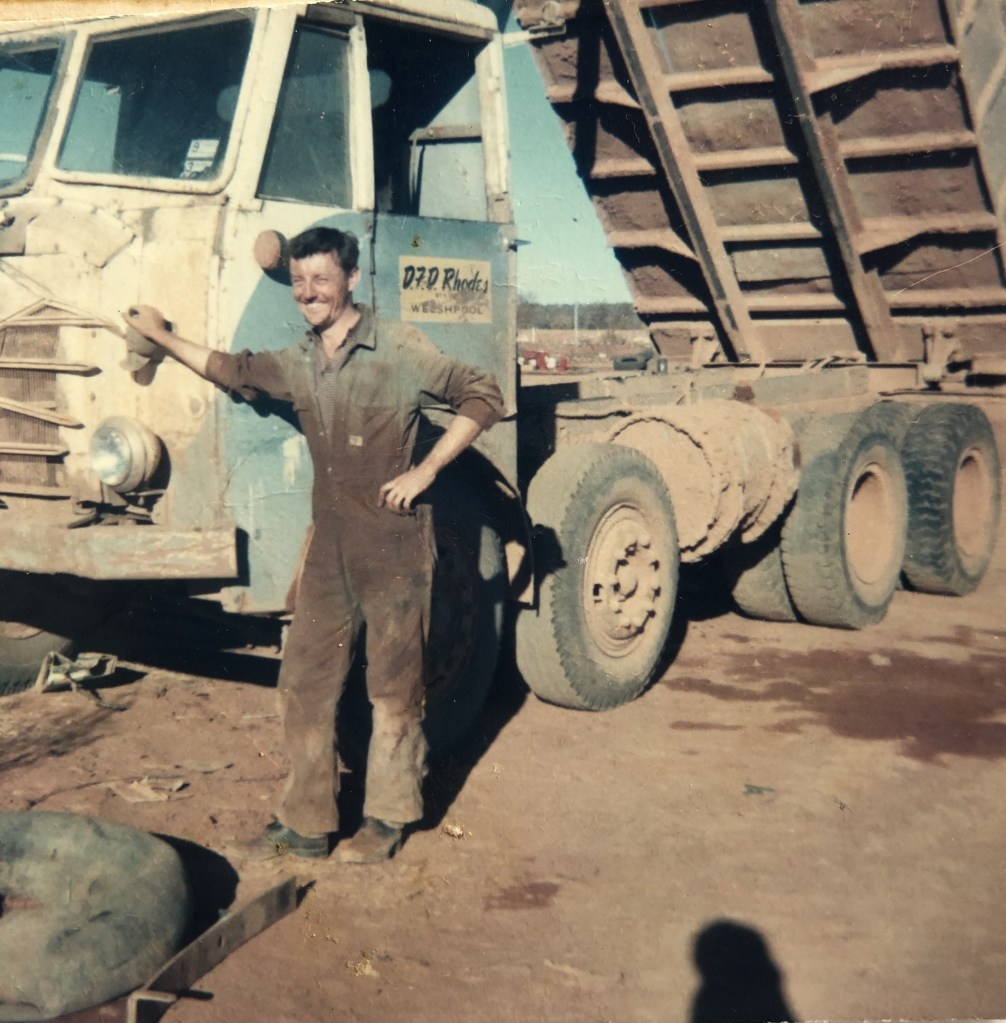
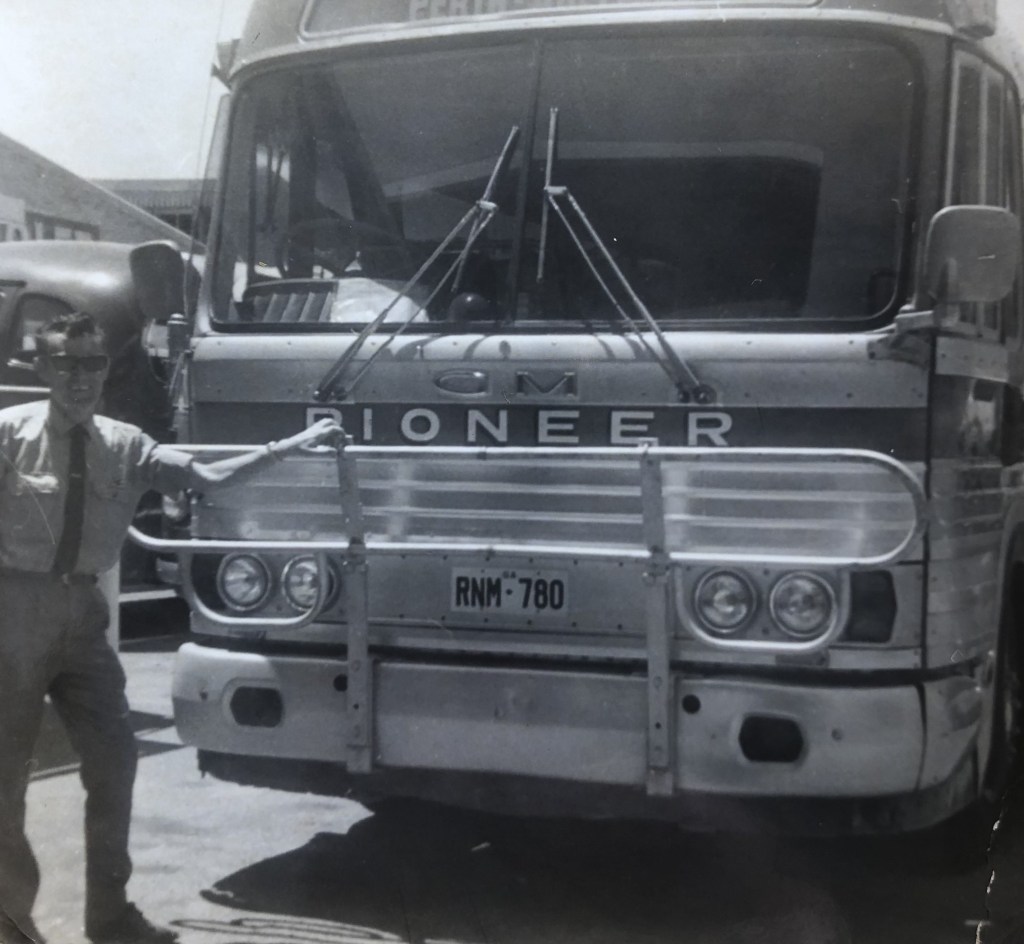
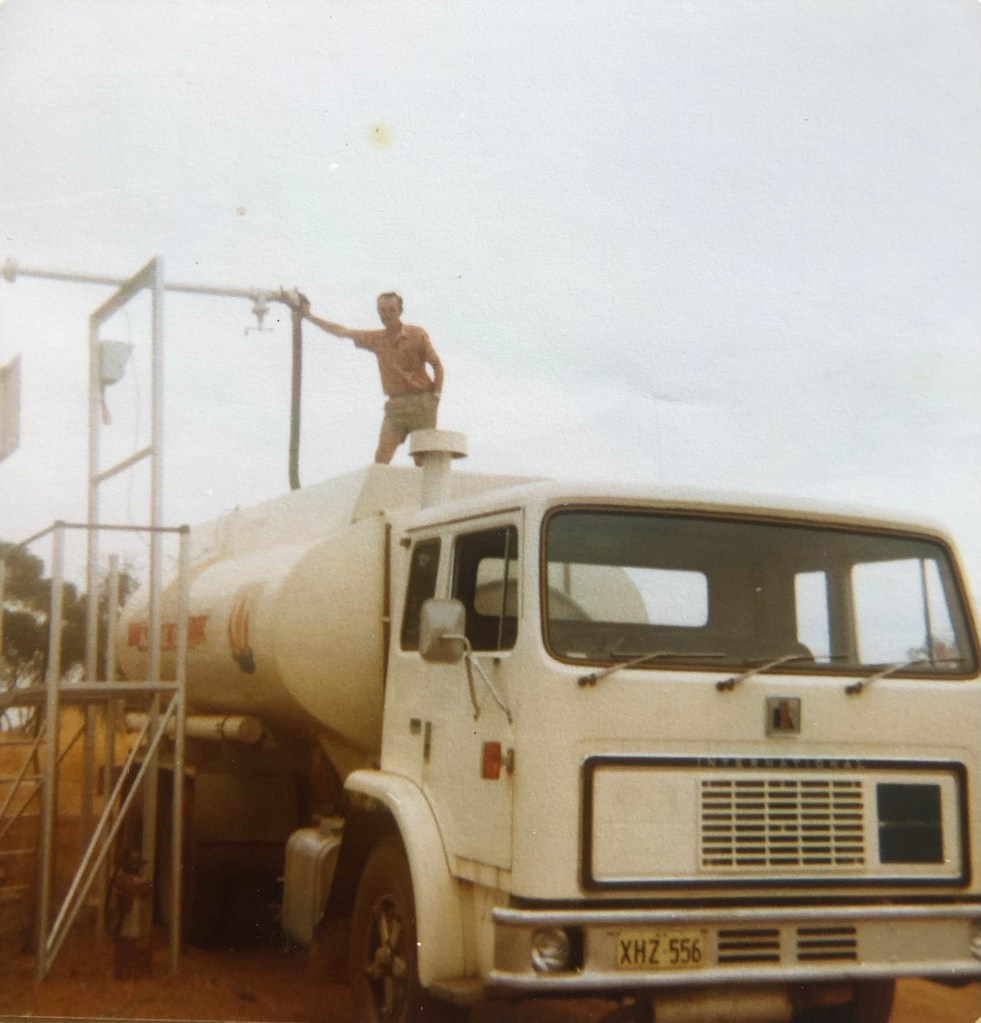
My dad was a driver by trade. In Britain, he had been a tank driver in the Army and a long-distance lorry driver. Driving would remain his occupation throughout most of his working life in Australia.
Not long after we arrived, he worked up north, where the distances were enormous, the roads could be unforgiving and the heat was intense. Over the years, he drove trucks, city buses, long-distance coaches and fuel tankers.
I’m sure Dad’s own experiences in the workforce helped shape Mum’s observations.
The newspaper article …
In her third letter from Australia, Mrs Christine Lucas, formerly of Runcorn, takes employment “down under” in the State of Western Australia as her subject, and comes to the conclusion that the state motto could be fairly said to be “Work hard – play hard”.
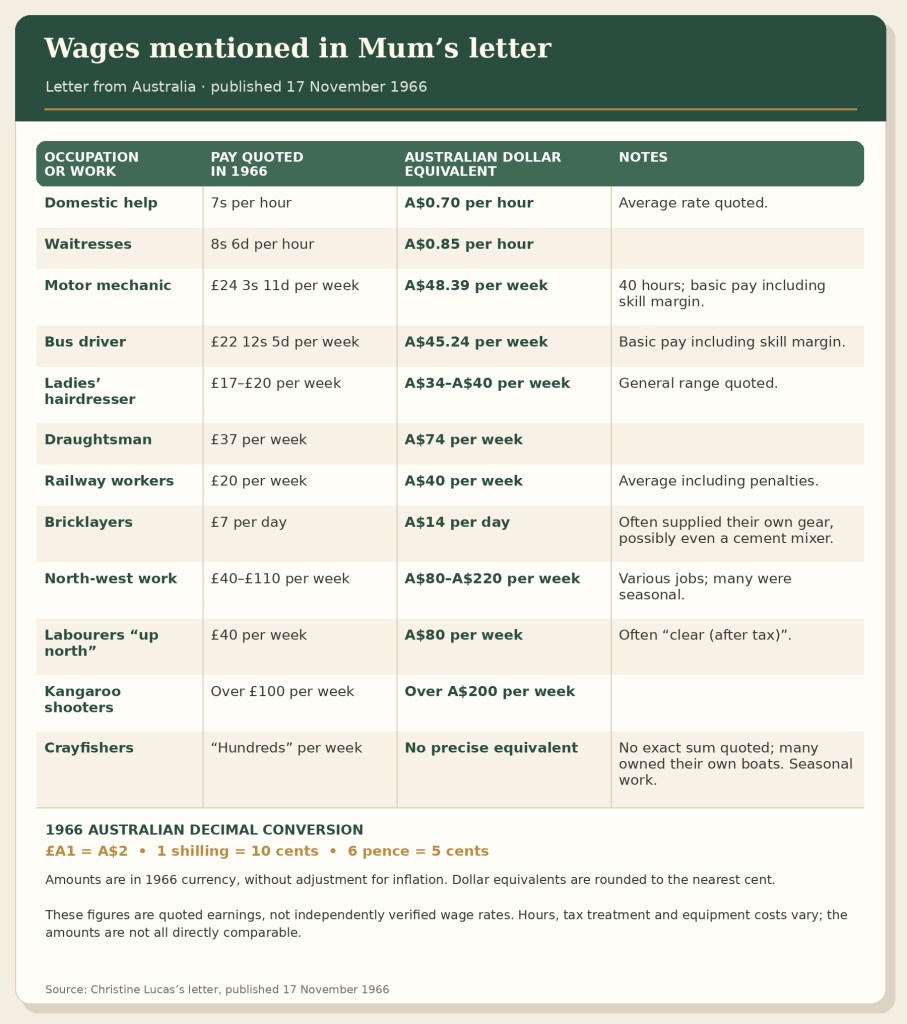
“Advertisements in the situations vacant column of the daily paper,” she writes, “cover every type of employment, including labouring jobs, barmaids, hospital matrons, radio operator for the flying doctor service, photographic models, even posts in the government and teaching positions in Canada! Domestic help is very much in demand, at an average of 7/- per hour. Waitresses earn 8/6 an hour. However there are not many jobs for married women. It is only as more migrants arrive with wives that are used to working that more jobs are opening up for married women. In the past week another baby-minding centre has opened up, and another is advertised as starting in December, as the idea of working wives and mothers is catching on.
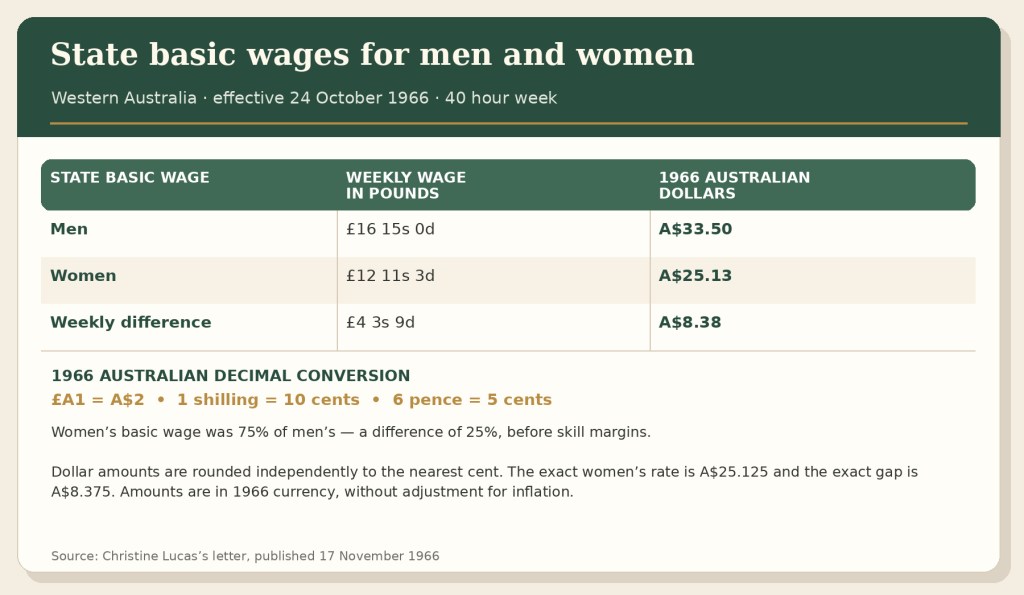
The State basic wage for 40 hours is £16 15s for men and £12 11s 3d for women from 24th October 1966. There are also ‘margins’, this is an amount varying with the amount of skill involved in the work, which is paid along with the State basic. These two amounts together form the basic wage for each particular skilled job. The basic pay for a motor mechanic is £24 3s 11d for 40 hours; for a bus driver it is £22 12s 5d. A ladies’ hairdresser generally earns between £17 and £20 a week, a draughtsman £37, and the railway workers are as poorly paid as in England (averaging, with penalties, £20).
Bricklayers and carpenters are advertised for every day, I think anyone with a trade training could probably get on alright here, but tradesmen must sit for a written examination here to gain their Australian qualifications before being able to get a decent job. Examinations are held regularly and good British tradesmen usually have little difficulty. However, we have heard of cases where it has not all been plain sailing, so it may be necessary to swot up on the theory side before leaving for Australia.
Self confidence is about one’s biggest asset here, the Australians are a confident nation and expect it in others. For every job there are many replies and obviously the one who puts himself over best gets the job.
In most trades you need your own tools. Butchers have a metal pouch on their belts which holds all their own knives, etc; truck drivers often need to buy their own overalls and ropes. Bricklayers can earn £7 a day, but usually need to have their own gear, and this might even include the cement mixer!
The need to take examinations and the fact that you have to equip yourself for work were two of the biggest points we noticed were covered least in the migration literature.
If you fancy big money, the north-west is the place. Here you can earn £40 – £110 a week, but, as you can imagine you have to sweat for it – literally, often in temperatures up to 120 degrees. Also many jobs are seasonal. Driving on unmade roads in the monsoon season is impossible, and a lot of the road and rail building and the mining is abandoned for a time. The men then come back to the city causing a surplus of labour. Labourers ‘up north’ often clear £40 a week, and if they stay at the job for a period of six months they can claim all their tax back at the end of the financial year, which begins in July here. Tax in the city is slightly less than in the UK, doctors bills, union dues, gifts to charity, etc, are all claimed for at the end of the year, thus most people have an annual rebate.
Those earning the most money are probably the crayfishers and the kangaroo shooters. ‘Roo’ shooters work at night, going out with big lights on their trucks to spot the kangaroos, which usually hide in the daylight. There is a big demand for the skins which are used to make souvenirs – purses, tea-cosies, rugs and soft toys.
I hear the meat is exported as a delicacy, eaten here, or more usually, made into pet food along with rabbit meat. Kangaroo shooters earn over £100 per week but I don’t know if a ‘New Australian’ (as they like to call us) would be able to get a job like this very easily. I have seen adverts for deckhands and experienced crayfishermen. These men, most of whom own their own boats, earn hundreds each week, but they work hard and long hours and again it is only seasonal work.
To get an Australian driving licence (providing that you hold a current British licence) you have to take a written test at a police traffic office. This is often nicknamed “The Police State” because the police seem to do most things. The written test and the necessary eyesight test cost £2; the actual licence costs 30/- (yearly), is issued on the spot if the test is passed. A wagon driver needs to furnish proof of what he has driven, and also to take a further test on the laws covering truck driving here. There is a leaflet which gives you all the answers, you just study it overnight. However, an actual driving test must be taken for a licence to drive articulated vehicles (called semi-trailers here), buses and taxis.
Again the police do the tests for these. An extra written test is required to get a bus driver’s licence. For anyone wishing to make driving their occupation out here all these tests make the first couple of weeks pretty expensive.
Some jobs do have overtime but in general the Australians like to just work the 40 hours. In that time though they, and consequently the New Australians, all work very hard, so anyone looking for an easy life would have a long way to look here. The motor industry has a 7-minute tea break in a morning and none in the afternoon. The motto of the West Australian can be pretty well fairly said to be ‘Work hard – play hard’ – for this they do.”
My Thoughts: 60 Years On
Looking for work
Much of my career focused on other people’s careers. I spent many years working in recruitment, learning and development and tertiary education. So many of the points highlighted in this article are very close to my heart, especially the gender pay gap and social changes.
Obviously, a lot of things have changed since 1966. I don’t remember the last time I saw a ‘situations vacant’ column in a newspaper. In fact, it’s rare that I read a physical copy of a newspaper. Many of our occupations have changed as well. That said, when it comes to applying for and securing a new role, I’d say that self-confidence is definitely still an asset that will help you land the right role.
Working conditions – then and now
Mum’s observations about the 40-hour working week and the motor industry’s seven-minute morning tea break are another reminder of how much working life has changed. Today, the standard full-time working week in Australia is generally 38 hours, and employees have access to a range of leave entitlements and workplace protections that were very different in 1966.
Technology has transformed how and where many of us work. Flexible hours, working from home, job-sharing and parental leave have made it easier for some employees to balance their working and family lives. Of course, not everyone has these options. A truck driver, nurse, tradesperson or hospitality worker cannot necessarily work from home, and many jobs still involve long hours, shift work and physically demanding conditions.
Nevertheless, the expectation that work should accommodate family responsibilities, rather than the other way around, has become a much more prominent part of the employment conversation.
Working Wives and Mothers
I was fascinated to read Mum’s observation that there weren’t many jobs for married women. Interestingly, the day after her article was published in Britain — 18 November 1966 — the Commonwealth Government lifted its marriage bar. Until then, permanent female Commonwealth public servants were generally required to resign when they married. The prevailing assumption was that husbands would support their wives and that employing married women could deprive men of jobs.
In Western Australia, it was the 5th December 1967 when the Public Service Amendment Act 1967 relaxed the marriage restrictions. Married women could be appointed or continue working after marriage, subject to the Public Service Commissioner’s approval. For school teachers, a vocation which attracted many women, on 12th November 1968 new regulations allowed permanent female teachers to apply to remain employed after marriage, subject to approval and conditions.
Mum also commented on the opening of “baby-minding centres … as the idea of working wives and mothers is catching on”. Prior to formal day-care centres, child-minding responsibilities for women who needed or wanted to go out to work would have been taken on by relatives, friends or neighbours.
How times have changed! According to the Australian Bureau of Statistics, in June 2025 almost three-quarters (73%) of Australian couple families with children under 15 had both parents employed. Even as late as 1979, that figure was just 40%.
Housing prices and the cost of living play a role in the need for two-income families but it isn’t just a financial decision. According to the Australian Department of Education’s statistics, 61% of domestic bachelor’s degree completions in 2024 were by women. Education and career choice have given women so many opportunities that their 1960s counterparts could never have dreamed about.
Taxation
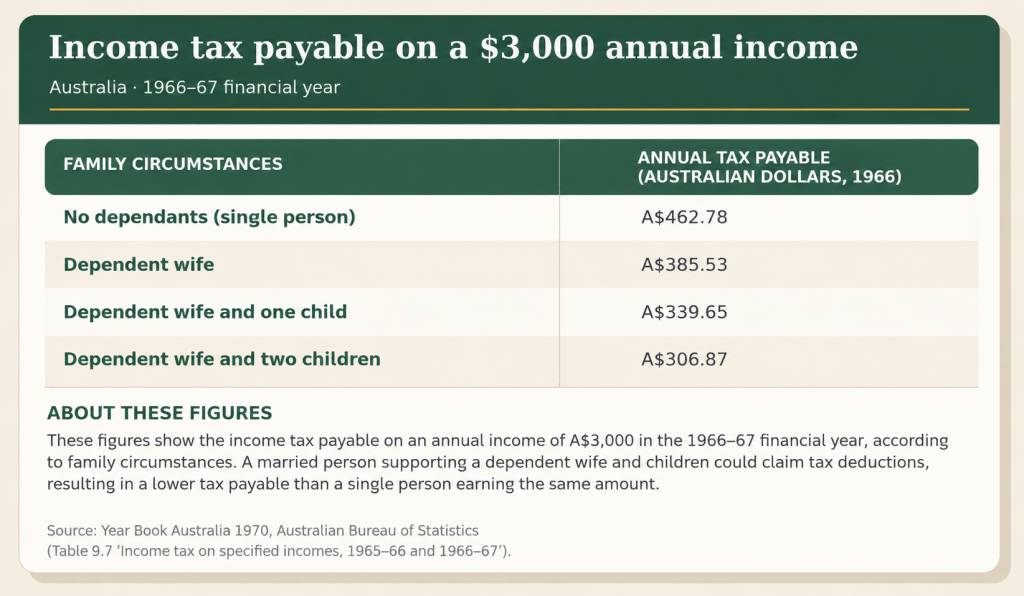
In 1966, Australian income tax took account of family circumstances. Although everyone was subject to the same individual tax scales, a married person supporting a dependent spouse could claim a tax deduction, with further deductions for dependent children. Consequently, a married man supporting a wife and two children generally paid considerably less income tax than a single man earning the same amount.
It was another factor in family work decisions. A man with a dependent wife paid less tax, and if that wife went out to work, she was likely to earn a fraction of what a man could earn and her husband could lose some or all of the tax benefit.
The Gender Pay Gap
It may seem unbelievable to many young people today that Western Australia’s state basic wage for women was 25% lower than the rate for men. Today, minimum wage rates do not differentiate on the basis of sex.
In 1966, the difference between men’s and women’s basic wages was built into the wage-setting system. Women could legally be paid less than men simply because they were women. Today, equal pay for the same or comparable work is a legal requirement, but a gender pay gap still exists. The difference now reflects a more complex range of factors, including the concentration of women in lower-paid industries, fewer women in senior positions, career interruptions to raise children, and the greater proportion of women working part-time. We’ve come a long way since 1966, but there’s still work to be done.
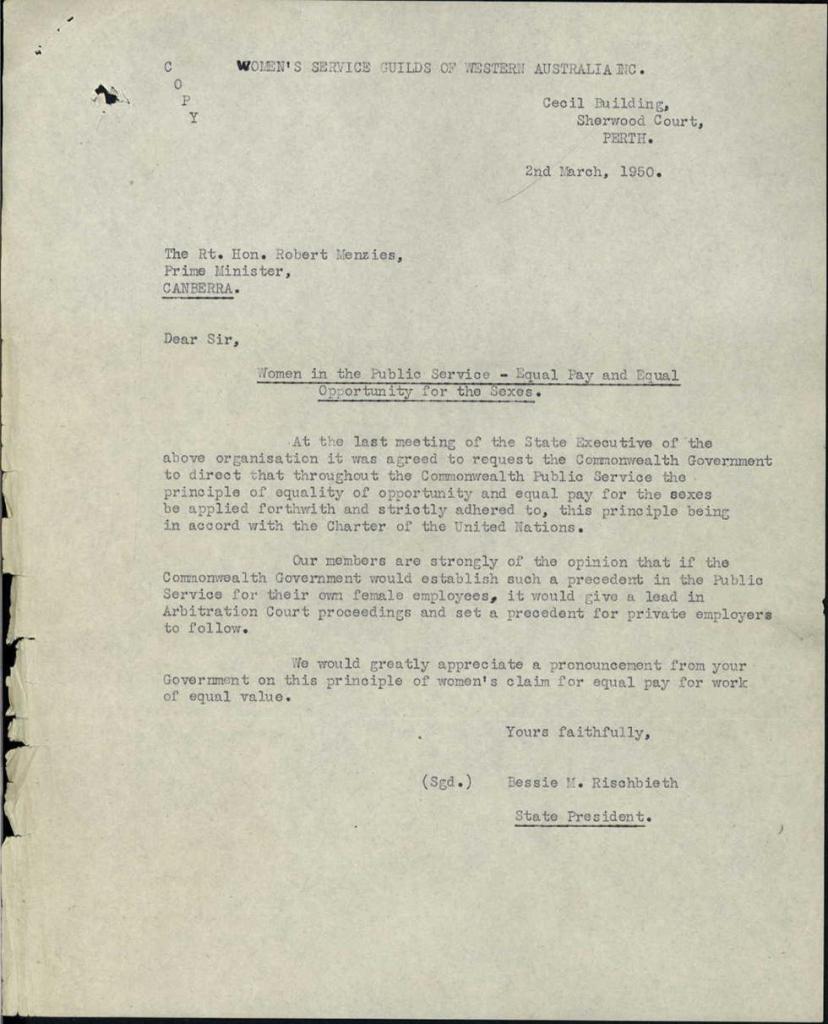
The fight for equal pay for equal work was a long one. On the National Archives of Australia’s website we find a letter dated, 2 March 1950, from the Women’s Service Guilds of Western Australia. The President, Bessie M. Rischbieth, wrote to Prime Minister Robert Menzies calling for changes in the Commonwealth Public Service, requesting, “the principle of equality of opportunity and equal pay for the sexes be applied forthwith and strictly adhered to”.
She then made a particularly interesting argument: if the Commonwealth Government established equal pay for its female employees, it would set a precedent for industrial arbitration proceedings and private employers.
In other words, these women weren’t simply asking for better wages for public servants. They recognised that government leadership could help change employment conditions throughout Australia.
It would, however, be more than two decades before equal pay for public servants was fully implemented. It was introduced progressively in the Commonwealth Public Service following the 1969 equal-pay decision. The broader principle of equal pay for work of equal value was established in 1972 and implemented in the Commonwealth Public Service in 1973.
But achieving equal pay for men and women doing the same work in the Commonwealth Public Service didn’t mean there was suddenly a level playing field everywhere. Even today, traditionally female-dominated occupations, such as childcare and aged care, can be paid less than jobs of comparable value in traditionally male-dominated industries.
Driver’s Licences
Today’s British migrants would be pleased to know that they can now transfer their standard UK driving licence to a Western Australian licence without having to sit a theory or practical driving test. Similar arrangements apply to licence holders from more than 40 recognised countries, although different requirements may apply to commercial vehicle licences.
Further Reading
Removal of the marriage Bar for female public servants – Parliamentary Education Office
Western Australian changes for married women in the State Public Sector and the Department of Education
Current working family statistics: Labour Force Status of Families – Australian Bureau of Statistics
Gender Differences in Australian Higher Education – Strategy, Research and Policy in Education
The long road to gender pay equality in the Commonwealth Public Service – National Archives of Australia
Equal Pay for Australian Public Servants – Press Statement by then Prime Minister Gough Whitlam (23rd July 1973) – Department of the Prime Minister and Cabinet – PM Transcripts
Notes for the Letters from Australia series:
The Ten Pound Pom scheme
We came to Australia under the Australian Government’s Assisted Passage Migration Scheme. By the 1960s, each adult paid £10 sterling towards the journey, while children travelled free. For our family, Mum and Dad’s fares therefore cost a total of £20. The scheme brought more than a million British migrants to Australia between the late 1940s and early 1970s.
The National Museum of Australia’s history of the postwar immigration drive provides an excellent introduction to the scheme. The National Archives of Australia also holds original promotional material describing the assisted fares.
Pounds, shillings and pence
Although Australia had introduced decimal currency in February 1966, the Runcorn Weekly News presented these Australian wage figures in pounds, shillings and pence. Comparing them with official Australian wage records confirms that they correspond to the former Australian currency, converted at £A1 = A$2, rather than British pounds sterling, which had a different value: at the exchange rate then operating, £A125 equalled £100 sterling, making £1 sterling worth approximately A$2.50. The Australian Bureau of Statistics explains the historical relationship between the two currencies.
Coming soon: Letter 4: Housing Can Be a Problem, in which Mum explores the challenges of renting, buying and furnishing homes.
See also:


Leave a Reply