Letters from Australia Series: Letter 2
First Impressions
In Flight Across the World, published on 22 August 2026 – the 60th anniversary of our arrival in Perth, Western Australia – I shared my Mum’s first letter to the Runcorn Weekly News, a British newspaper. It described our journey from the north of England to our new Australian home.
The second article in the Letters from Australia series was published on 10 November 1966. It describes Mum’s first impressions of Perth and Fremantle and addresses one of the most practical concerns for a young mother: the cost of feeding a family of four in Australia compared with England.
The newspaper article …
The second of a series of letters from Australia deals with a subject which creates a problem for housewives the world over … shops and the prices they charge.
Twenty-two-year-old Christine Lucas went to Australia over two months ago with her husband Keith and their two children, Kevin and Karen.
Mrs Lucas, formerly Christine Edwards, was born in Ann Street, and lived the greater part of her life in Runcorn at their Halton Road home, up until the time of her marriage.
Her letter reads:
“It was dark when we arrived in Perth. By the time we had all loaded into my brother’s car and left the airport many of the roadside lights had been turned off and we saw very little, other than dark shapes. We were taken straight to our flat in the coastal resort of Cottesloe.
We had, in fact, been going to go to Point Walter, a West Australian migrant hostel. However my brother Geoffrey Edwards and his wife, (formerly Audrey Bellis of Weston Point) had taken one look at the hostel and offered to accommodate us at their place. However they found us a flat and spent much time and effort in making it look homely for us. When we arrived the electric fire was on, beds made, complete with hot water bottles. It looked nice and cosy and felt lovely and warm after the cold wintry night air outside. We were grateful for this, for we felt the cold after the heat of India, Burma and Singapore, places we had been only hours previously.
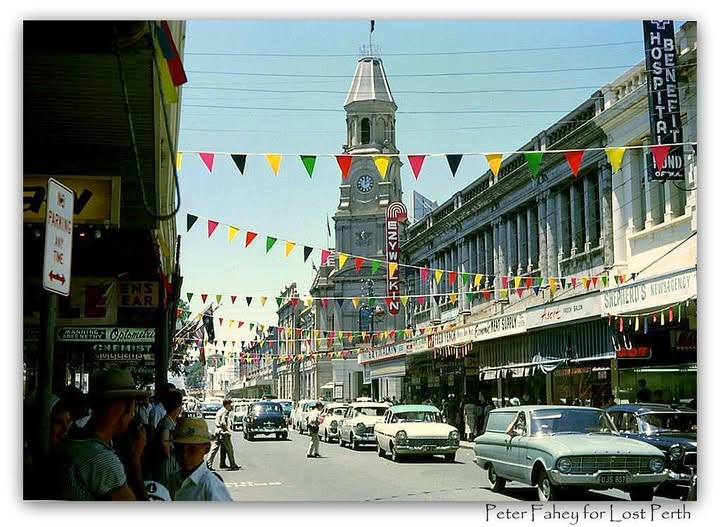
It was three-thirty when we finally got to bed; but we were eager to see our new country. That afternoon we went into Fremantle. I must admit that we were bitterly disappointed and wondered just what we had let ourselves in for. Everywhere looked so very unsightly… storage depots, flour mills – the usual warehouses of port towns. Going to Fremantle from Cottesloe you have to cross the Swan River and there is a good view of the dock areas. At first such things as the cranes and other unsightly machinery glared out at us.
Now we don’t notice these things as we take an interest in the ships and whenever there is one open to the public we have a look around it. Our flats are on the Ocean front and the shipping channel runs directly outside, about two miles out, so we have a good view of incoming and outgoing vessels. Often we go in the car down to the coast to watch the ships come into dock. There is free movement allowed on the docks and the authorities have even put electric lights on the jetties for the benefit of fishermen!
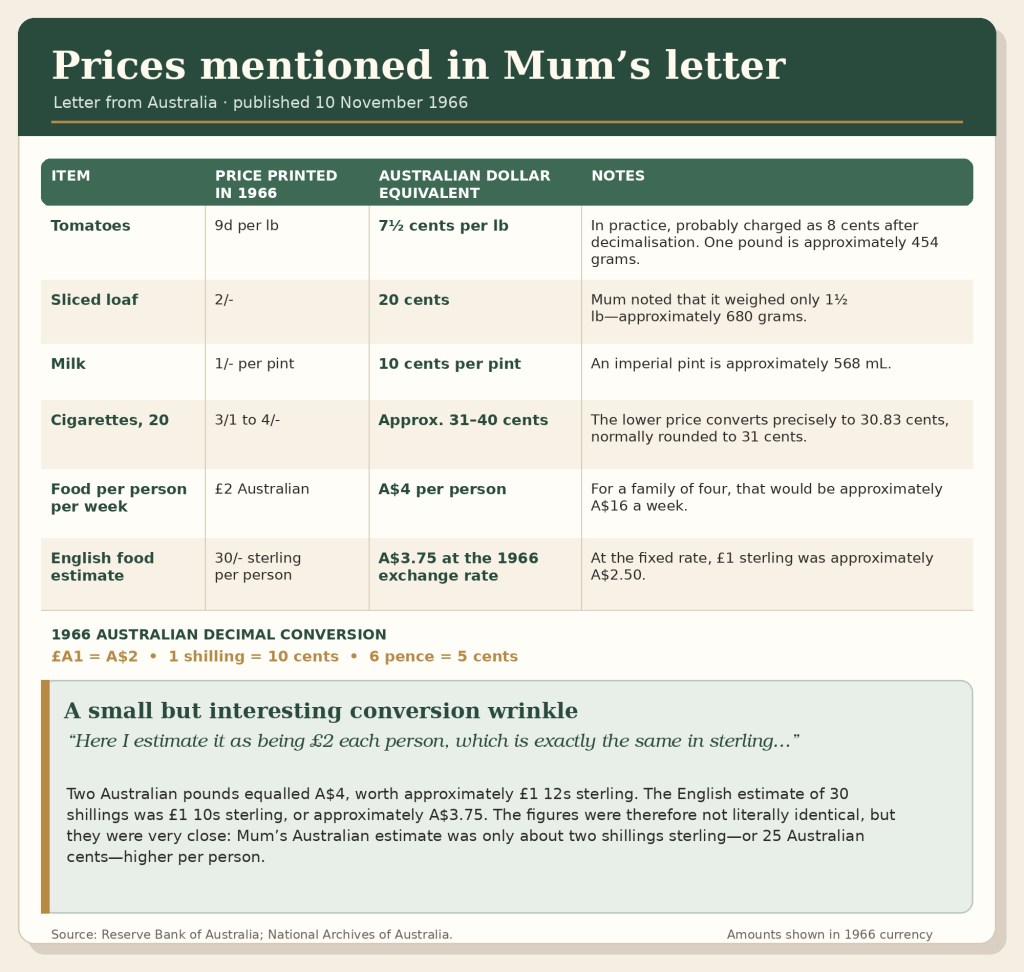
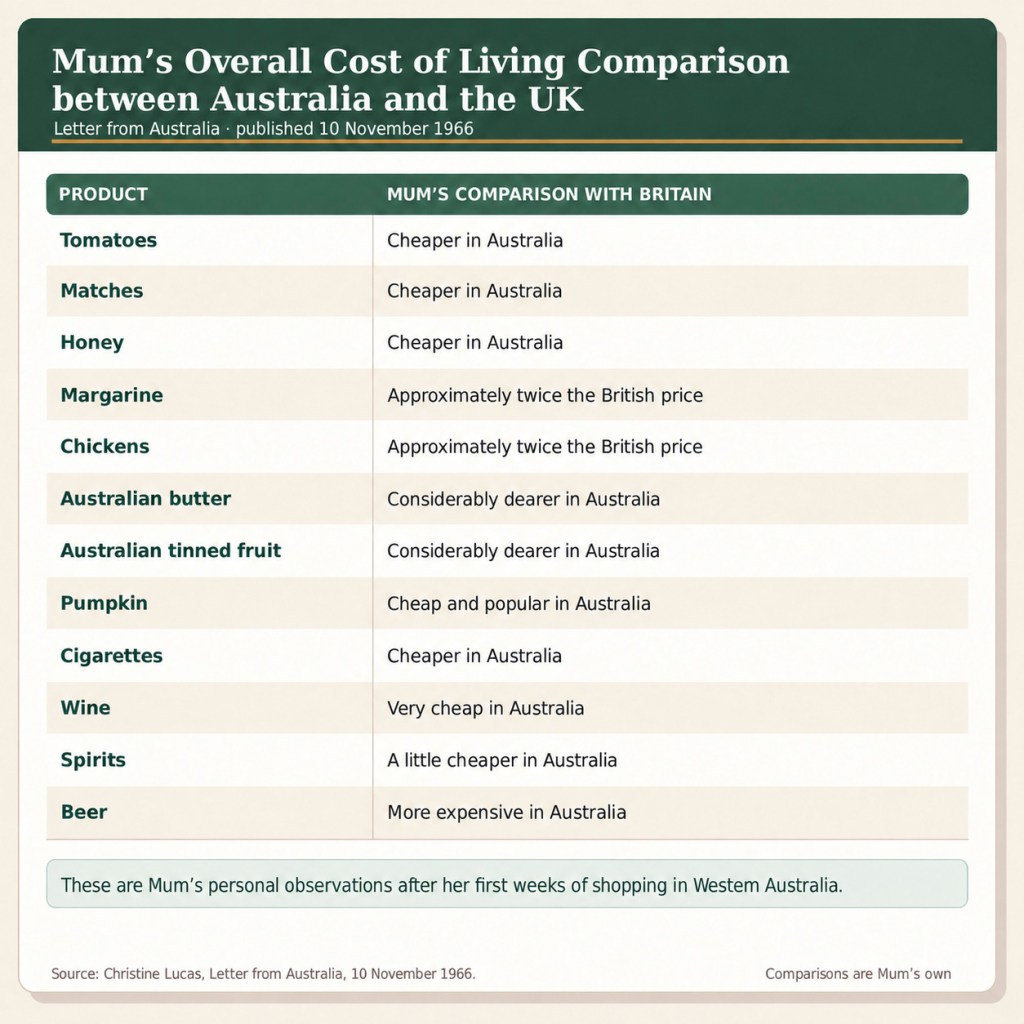
Fremantle has a friendly atmosphere and some good shops including one devoted exclusively to material. All the shops have covered fronts – this makes it cooler to shop by providing shade. Supermarkets have room inside the doors to park babies prams off the streets, and shelves to leave bags which may already contain shopping. When we arrived, tomatoes were on 9d a pound but these, matches and honey were the only things which stood out as being cheaper than in England. Margarine is twice the price here, so are chickens. A sliced loaf, only 1 ½ lbs in weight, costs 2/-, milk is 1/- a pint and there is no such thing as cheap milk for children. Our greatest surprise was to find that Australian butter and tinned fruits are considerably dearer here than in the U.K.
Most things taste different from the tastes we are used to so this fact, plus the currency change (we use dollars and cents) makes shopping doubly difficult at first. The girls in all the shops are very helpful and service is prompt.
A cheap and popular vegetable here is pumpkin. They do not sell watercress or mustard cress here. An English report put the cost of food in England at 30/- per person per week; here I estimate it as being £2 each person, which is exactly the same in sterling – but it seems more here!
We have noticed that cigarettes are cheaper, from 3/1 – 4/- for 20. Wines are very cheap, spirits are a little cheaper, but beer is more expensive. Australians think that their beer is the best in the world but opinions differ greatly. This is one thing you don’t comment on in public.
Our greatest shock was to see everywhere littered with broken bottles and Coke cans. Several times we have heard breaking glass and turned to see a bottle splatter all over the pavement – disposed of from a passing car. And it’s not the teenagers who are to blame – you have to be over 21 to drink here. They do keep broken glass from their marvellous beaches though.”
Currency and Comparisons
My Thoughts: 60 Years On
Life in Cottesloe
Our first address in Australia was 80 Marine Parade, Cottesloe, on the corner of Deane Street. We were in a small flat behind the main house – what we’d call a granny flat today. My uncle and his family lived close by.
Directly across Marine Parade lay the beach and the vast expanse of the Indian Ocean.
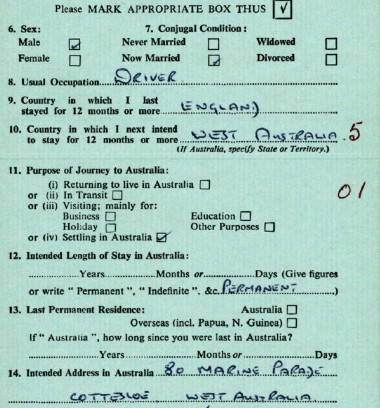
Cottesloe is now one of Perth’s pre-eminent suburbs, part of the “Golden Triangle”, as the exclusive western suburbs are colloquially known. Today, according to REIWA (Real Estate Institute of Western Australia), its median house price is more than A$3.5 million and the median rent is A$1,350 per week. Needless to say, a flat in Cottesloe would now be well beyond most young migrant families’ means.
Mum wrote about her initial disappointment during that first afternoon’s drive into Fremantle, but I wonder what she and Dad thought when they awoke and saw the Indian Ocean just across the road.
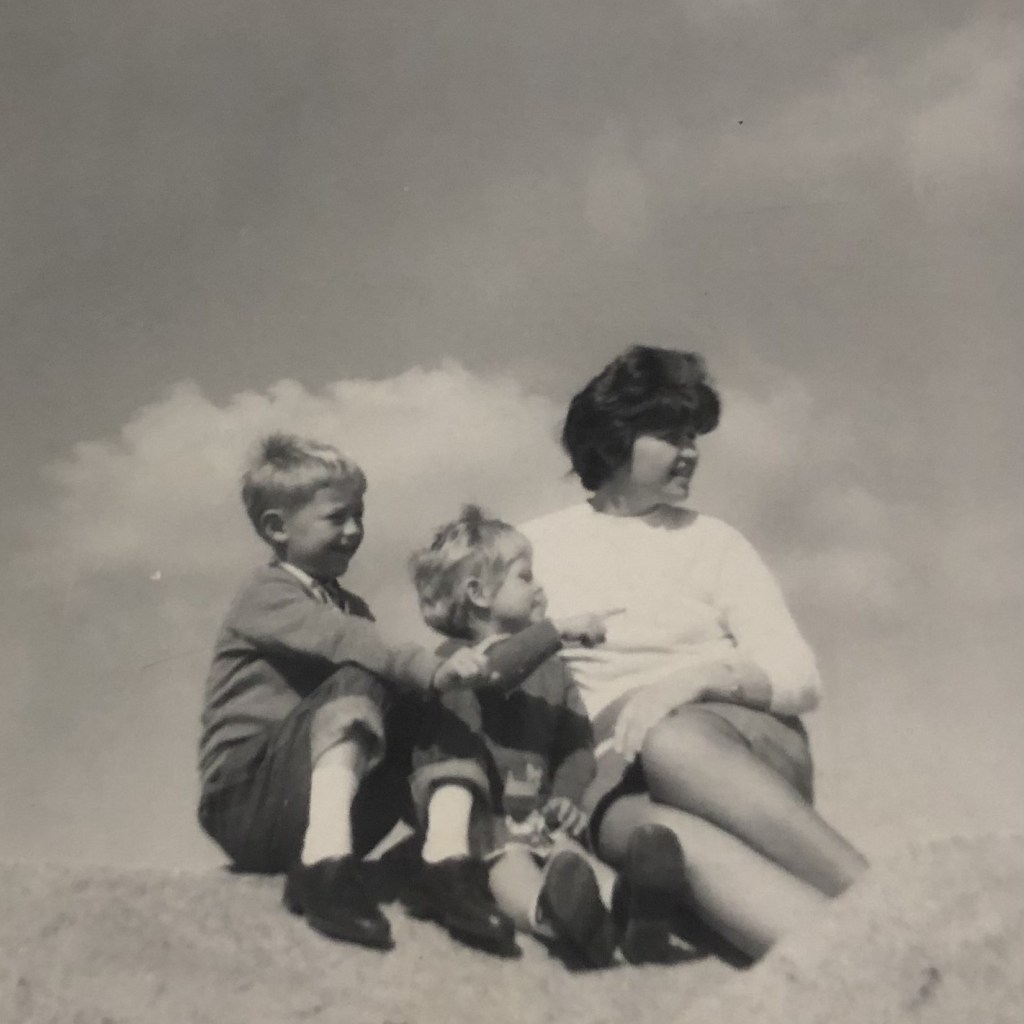
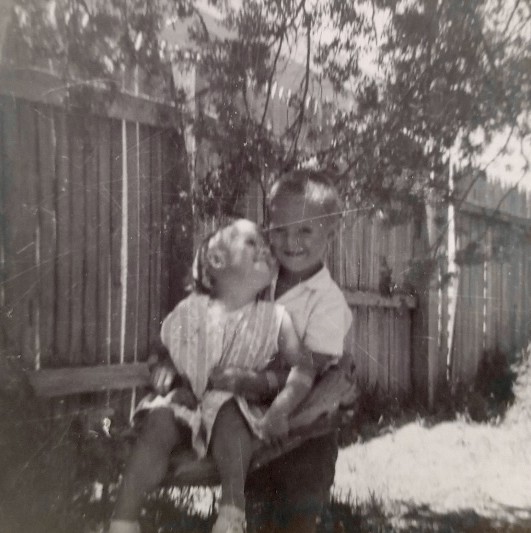
I’m not sure how long we stayed at the Marine Parade flat, but we do have a photo of my brother and me with “Kevin and Karen, Marine Parade 1967” written on the back. When we eventually moved, it was to an old two-bedroom cottage with a sleep-out and an outdoor toilet, a couple of kilometres further north in Cottesloe, where we lived until 1971. My first school was Cottesloe Primary. I have happy memories of the years we spent living near the beach in Cottesloe, and even today, when I visit, I feel like I’m “coming home”.
A few years ago, I asked my uncle why they chose to come to Perth rather than anywhere else in Australia. He said it was because his wife’s cousin was living there and they said it was great. That cousin lived in the neighbouring suburb of Mosman Park, which is where they went to stay when they first arrived. How different our lives – and my early memories – might have been, had that cousin lived elsewhere in the metropolitan area.
Migrant Hostels
Mum mentioned that we were originally booked into the Point Walter Migrant Reception Centre. At the time, migrants were housed in reception centres and camps across Australia. With its old wooden huts, this camp, as my uncle and aunt had discovered, was far from luxurious. The Point Walter Centre was built in 1941 as an army training camp. Over the years it became an internment camp and then an army rehabilitation hospital before being leased by the Commonwealth Government to house “new Australians” (source: Heritage Council of Western Australia).
The Australian-British television drama Ten Pound Poms offers a dramatised glimpse of what life was, or could have been, like in the migrant camps.
Fremantle Port
I guess it’s unsurprising that we spent a lot of time visiting the Port of Fremantle. Dad grew up in Liverpool, another port city, and his father was a radio officer in the British Merchant Navy, so ships had always been a big part of his life. I loved going on board and looking around the visiting ships. Again, that’s something that wouldn’t happen today with increased security everywhere.
Shops – Then and Now
Australia had changed to decimal currency only six months before we arrived, so Mum was still adjusting to dollars and cents. However, the newspaper presented the prices in pounds, shillings and pence for its British readers. The local prices appear to have been expressed in Australian pre-decimal currency. Mum estimated that feeding one person cost about £A2 a week – equivalent to A$4, or A$16 for our family of four. See the currency and exchange-rate details in the notes below.
Life was a lot simpler in the 1960s in so many ways and I think, on the whole, there was more respect and honesty in the community. I can’t imagine parents today leaving their baby’s pram at the front of shops or people putting their completed shopping on shelves, ready to collect later. There were no security guards at the front of shops back then.
I found it interesting that Mum included the cost of cigarettes, spirits, wine and beer in her article. Mum and Dad didn’t smoke, and they weren’t big drinkers either, although I do remember Mum enjoying the occasional port and lemonade at parties. I guess it was something that was important to a lot of others and something her readers could relate to.
Mum commented on the taste of food as well as the prices. I love vegetables and one of my favourite veggies is pumpkin – roasted, mashed, in soup – it is delicious. It was obviously strange for Mum to see it displayed so prominently. I believe, even today, it’s not widely eaten in the UK.
Today’s Cost of Living
Today, the words “cost of living” and “crisis” seem almost permanently wedded together in news headlines. It certainly costs a great deal more to feed a family now than it did in 1966!
While researching this series, I came across Australian.com, a website providing practical information for people considering migrating to Australia today. Its guide to weekly grocery costs estimates that a family of four might spend:
- $250–$300 as a budget-conscious shopper
- $350–$450 as an average shopper
- $500 or more as a comfortable shopper
Even the lowest of those estimates works out at more than $60 per person each week. It makes Mum’s estimate of £2 a head sound as though it belongs to another world.
Littering
I find Mum’s comments on littering interesting. Thankfully, I don’t think it is nearly as confronting or widespread today. Heavy fines, container-deposit refunds, recycling programs, community clean-ups and better education have all helped change attitudes and behaviour.
Notes for the Letters from Australia series:
The Ten Pound Pom scheme
We came to Australia under the Australian Government’s Assisted Passage Migration Scheme. By the 1960s, each adult paid £10 sterling towards the journey, while children travelled free. For our family, Mum and Dad’s fares therefore cost a total of £20. The scheme brought more than a million British migrants to Australia between the late 1940s and early 1970s.
The National Museum of Australia’s history of the postwar immigration drive provides an excellent introduction to the scheme. The National Archives of Australia also holds original promotional material describing the assisted fares.
Pounds, shillings and pence
Britain still used pounds, shillings and pence in 1966, while Australia had introduced decimal currency on 14 February that year. Nevertheless, the Runcorn Weekly News presented the prices in the familiar pre-decimal form for its British readers.
The local prices appear to have been expressed in Australian pre-decimal currency. When decimal currency was introduced, £A1 became A$2. The Australian pound and pound sterling did not have the same value: at the exchange rate then operating, £A125 equalled £100 sterling, making £1 sterling worth approximately A$2.50. The Australian Bureau of Statistics explains the historical relationship between the two currencies.
Changing place names
In this article, Mum mentioned our transit stop in Burma. The country’s military government changed its English name to Myanmar in 1989, although both Burma and Myanmar are still used.
Coming soon: Letter 3: Self-confidence is the main asset, in which Mum explores employment and wages – including the very different State basic wage rates for men and women.


 Your Family Stories
Leave a comment