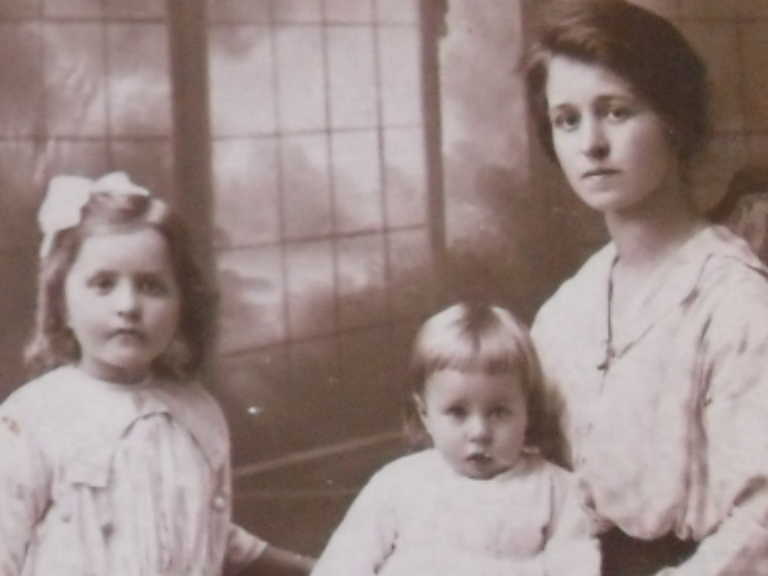
Image: Hannah Barnes, nee Cunliffe, with daughters Cissy and Gladys, circa 1920.
A Victorian Wedding with a Difference
On a September morning in 1877, an unusual crowd gathered at St Paul’s Church in Burnley, Lancashire. Some came out of curiosity. Others came because they had heard that something extraordinary was about to take place.
Victorian weddings often attracted spectators eager to admire the bride’s dress, inspect the groom’s appearance, or simply enjoy a little local excitement. But on this occasion, the attraction was something entirely different.
The bridegroom, Thomas Cunliffe of Oswaldtwistle, and the bride, Mary Kershaw of Burnley, were both deaf and mute from birth. The marriage service would not be spoken in the usual way. Instead, the familiar words would be translated into the language of the “deaf and dumb”.
A newspaper report published in The Blackburn Standard on 15 September 1877 described how “a considerable number of persons” attended the ceremony, including members of “the sterner sex”, who rarely appeared at morning weddings. They had come to witness something they had never seen before: a church wedding conducted through sign language.
A Silent Ceremony in a Noisy World
It is difficult to imagine today just how unusual this must have seemed to Victorian observers.
Church services in the nineteenth century were dominated by sound. Congregations listened to sermons, hymns echoed through stone buildings, and marriage vows were spoken aloud before family and friends. Yet at St Paul’s Church that day, much of the ceremony unfolded through movement rather than speech.
The service was conducted by the Reverend J. Dowling, chaplain to the Manchester Deaf and Dumb Asylum, assisted by the church’s clergy. Far from diminishing the solemnity of the occasion, the newspaper noted that the ceremony was conducted with an impressiveness that actually enhanced its dignity.
One can picture the congregation watching intently as words were transformed into signs, allowing Thomas and Mary to participate fully in one of the most important moments of their lives.
Who Were Thomas Cunliffe and Mary Kershaw?
Thomas Ramsbottom Cunliffe was born on 27th August 1844, the eldest child of Henry and Agnes (Nancy) Cunliffe nee McGregor. Henry was a labourer, initially working as a mason’s labourer and later as a printworks labourer. Thomas grew up with his family in Oswaldtwistle, Lancashire.
Mary Kershaw was born on 11th November 1851 in Cliviger, Lancashire, a mining area near Burnley. Her father, James, was, unsurprisingly, a coal miner. Her mother was Rebecca Kershaw, nee Wild. Mary was the only daughter and had three brothers. Mary’s mother passed away in 1865, and on the 1871 census, Mary was living in Habergham Eaves, south of Burnley, with her father, step-mother Alice, brother William and 4 step-siblings.
Thomas and Mary were recorded on multiple census records as being “deaf and dumb since birth”. Despite growing up around 20 miles apart, Thomas and Mary eventually found one another through Lancashire’s close-knit deaf community.
Life as Deaf Children in Victorian Lancashire
Like many deaf children of the Victorian era, Mary Kershaw received her education at the Manchester Deaf and Dumb Asylum in Old Trafford. Records recently identified by the British Deaf History Society show that Mary was admitted to the institution on 31 July 1865 as Pupil Roll No. 654, when she was thirteen years old.
The asylum was more than a school. It was a social world where deaf children formed lifelong friendships and relationships, communicating through early forms of British Sign Language, fingerspelling, writing and gesture.
We still haven’t found any educational records for Thomas Cunliffe. He may have attended another school for deaf children, perhaps in Liverpool, Doncaster or elsewhere. We will probably never know whether they met through the Manchester institution, whose chaplain later officiated at their wedding, or through the wider network of Lancashire’s deaf community. It seems likely, though, that these shared social and educational connections eventually brought together a young man from Oswaldtwistle and a young woman from Burnley.
A Monumental Shift for the Deaf
In the 1870s, deaf education stood at a crossroads. Traditional sign-based teaching methods still flourished, but a movement known as “oralism” was beginning to gain influence. Oralist educators believed deaf children should be taught to lip-read and speak, often discouraging the use of sign language altogether.
Just three years after Thomas and Mary’s wedding, the infamous Milan Conference of 1880 would promote oralism internationally and lead to the suppression of sign language in many schools for decades. Their wedding, therefore, occurred during one of the last great periods in which sign language was publicly celebrated and respected within educational institutions.
Working in Lancashire’s Cotton Mills
There is another fascinating aspect to Thomas and Mary’s story.
They spent their adult lives working in Lancashire’s cotton industry. The census records show they were both cotton weavers.
Lancashire’s cotton mills were among the loudest workplaces in Britain. Thousands of power looms clattered continuously, creating a deafening environment where spoken conversation was almost impossible.
Hearing workers often relied on gestures, lip-reading and informal signs to communicate across the mill floor. Locally, this was sometimes known as “mee-mawing”.
For Thomas and Mary, however, communication through signs was second nature. In a workplace where everyone struggled to hear, their fluency in visual communication may have given them an unexpected advantage. Their deafness in this workplace could have been their superpower.
A Curious Census Entry
Thomas and Mary had three children: Agnes (born 1879), James (born 1883) and Hannah (born 1887).
One census entry raises an intriguing question. In 1881, two-year-old Agnes was recorded as being “deaf and dumb”.
As later census records and the course of her life showed, this was not the case. Was this simply an assumption made by an enumerator who knew her parents were deaf? Did a neighbour perhaps say to him, “They are all deaf in that house”?
It is impossible to know for certain. At just two years of age, many children are only beginning to develop understandable speech. Agnes may have been perfectly capable of hearing but slower to speak because sign language was the primary language used within the home.
Whatever the explanation for Agnes’s census entry, one thing is certain: Thomas and Mary raised a family that successfully bridged the deaf and hearing worlds.
Hannah’s Story
Their youngest daughter, Hannah, is my great-grandmother. In 1910, Hannah married Robert William Barnes in Oswaldtwistle. Her mother Mary, died in 1909 and her father, Thomas, in 1913, not long before Hannah’s own children were born. Hannah taught sign language to her two daughters, Cissy (my grandmother, born 1914) and Gladys (born 1918). My grandmother, in turn, taught sign language to her own children. Even after the original reason for learning those signs had faded with time, the language remained as a treasured family inheritance.
What makes this story even more remarkable is that the connection has continued into the twenty-first century.
From Victorian Sign Language to Modern Auslan
A few years ago, my brother and his wife both decided to make a career change. After learning Auslan—the Australian sign language—they gained qualifications and commenced work in Queensland schools as Educational Interpreters, helping deaf children access education and communicate confidently in the classroom.
CODA, DODA and a Legacy That Continues
When I spoke recently with my brother about our family history, he reminded me of the acronym CODA, meaning “Child of Deaf Adult”—a term widely used within the deaf community. We laughed as we realised that perhaps a new acronym could apply to us: DODA—”Descendants of Deaf Adults.”
Of course, it is not an official term, but it perfectly captures how the influence of Thomas Cunliffe and Mary Kershaw continues to ripple through the generations. Nearly 150 years after their wedding, their descendants are still connected to the deaf community, still learning its languages, and still helping to build bridges between deaf and hearing worlds.
Legacy of Love
When Thomas Cunliffe and Mary Kershaw stood at the altar of St Paul’s Church in 1877, the inquisitive crowd saw a novelty—a silent ceremony in a roaring industrial world. They could not have foreseen how beautifully that silence would flourish.
The dignity witnessed that day did not fade with the echo of the vows. It lived on through Hannah, through my grandmother Cissy and her sister Gladys, through the generations that followed, and now through Thomas and Mary’s great-great-grandson and his wife, who have worked with deaf children on the other side of the world.
For me, that is what family history is about—not merely names, dates and records, but discovering the remarkable human stories that continue to shape lives long after the people themselves have gone.
And perhaps that is the greatest legacy Thomas and Mary left behind: not simply a family tree, but a continuing story of connection, communication, and an enduring vocabulary of love.
Postscript: After this article was first published, the British Deaf History Society (BDHS) identified Mary Kershaw in the admission records of the Manchester Deaf and Dumb Asylum, confirming that she entered the school on 31 July 1865 as Pupil Roll No. 654. I have edited this post so it now reflects the facts as we know them, and I’m grateful for the assistance of the BDHS. (3 June 2026)
Family History Research Notes: Thomas Cunliffe (1844–1913) and Mary Kershaw (1851–1909) lived in Oswaldtwistle, Lancashire and worked as cotton weavers. Researchers with connections to the Lancashire deaf community, the Manchester Deaf and Dumb Asylum, Burnley, Oswaldtwistle, Cliviger, or the Cunliffe and Kershaw families are welcome to get in touch via this blog or by emailing me: kaz747.thompson@gmail.com – Thanks, Karen, Perth, Western Australia.

Image: The news article about the wedding – original above and transcription below
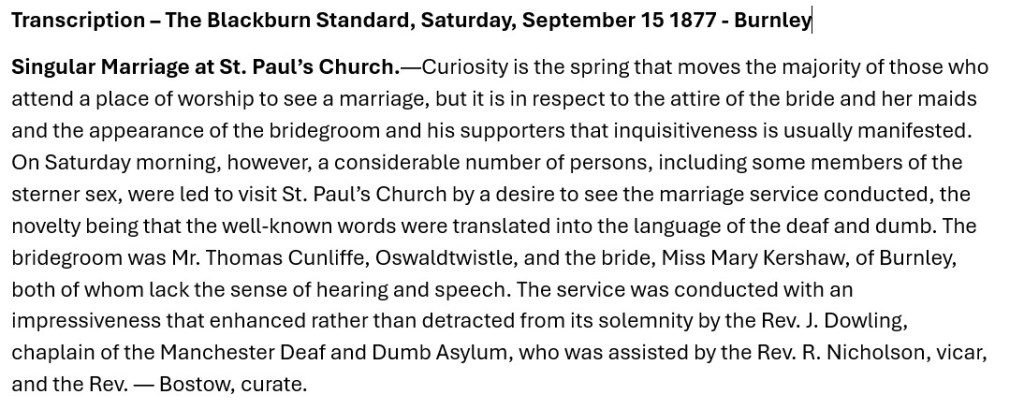
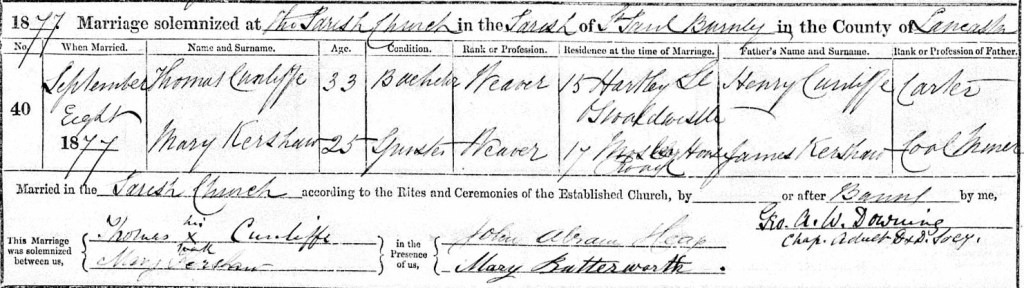
Image: The marriage record for Thomas Cunliffe and Mary Kershaw
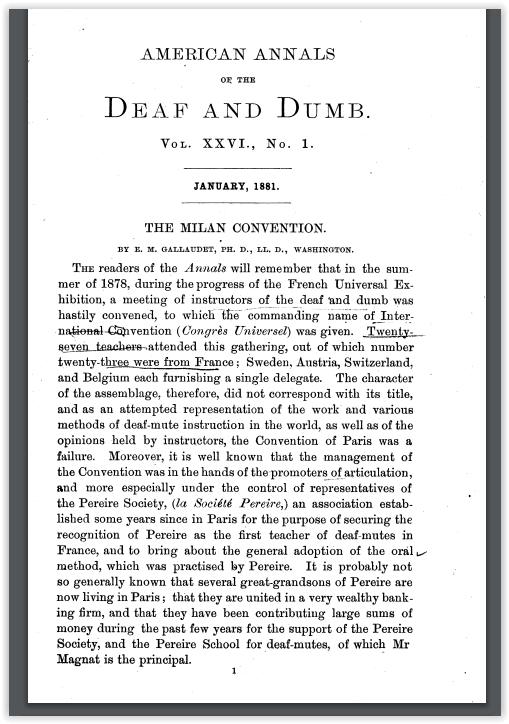
Image: American Annals of the Deaf and Dumb, January 1881. The Milan Conference of 1880 marked a turning point in deaf education, promoting oralism and contributing to the decline of sign language in many schools. Source: https://deafhistory.eu/index.php/component/zoo/item/milan-1880-what
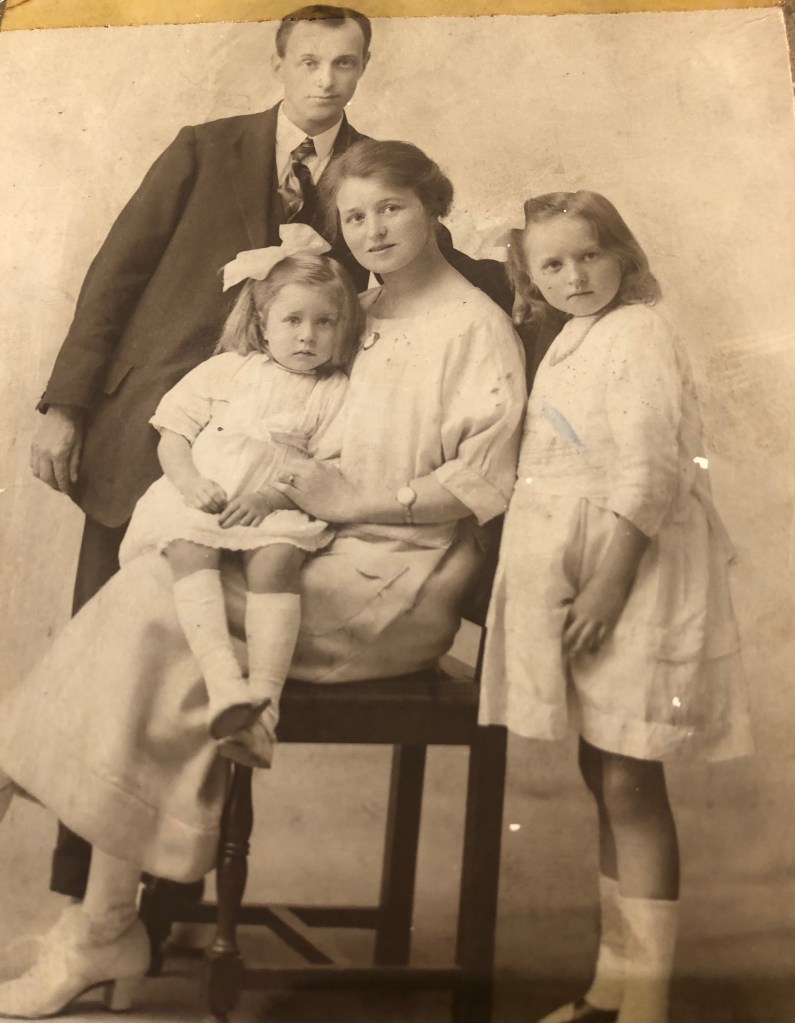
Image: Robert and Hannah Barnes, nee Cunliffe, with daughters Cissy and Gladys, circa 1922
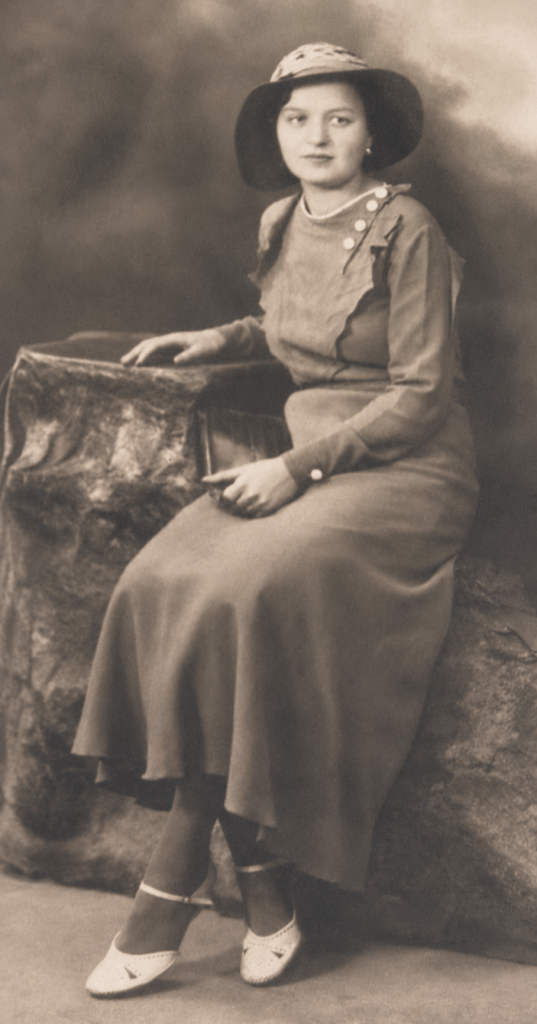
Image: Cissy Barnes, circa 1934 – one of my favourite photos of my grandmother
Sources
Newspapers
The Blackburn Standard (Blackburn, Lancashire, England), 15 September 1877, report of the marriage of Thomas Cunliffe and Mary Kershaw at St Paul’s Church, Burnley.
Civil Registration Records
England and Wales General Register Office (GRO):
- Birth registration of Thomas Cunliffe, 1844.
- Birth registration of Mary Kershaw, 1851.
- Marriage registration of Thomas Cunliffe and Mary Kershaw, Burnley Registration District, September Quarter 1877.
- Death registration of Mary Cunliffe (née Kershaw), 1909.
- Death registration of Thomas Cunliffe, 1913.
Census Records
England Census returns, 1851, 1861, 1871, 1881, 1891, 1901 and 1911, documenting the Kershaw and Cunliffe families.
Family Records and Photographs
Private collection of the author, including family photographs, family documents and oral family history passed down through descendants of Thomas Cunliffe and Mary Kershaw.
Historical Background
Research into nineteenth-century deaf education, British Sign Language history, the Manchester Deaf and Dumb Asylum, the Milan International Congress: Education of the Deaf, and the Lancashire cotton industry.


 Your Family Stories
Leave a comment