
The Surprising Stories Hidden in Family Death Certificates
Have you ever visited a doctor who asked about your family’s health history?
Questions like: “Is there any heart disease in your family?” “Does anyone have asthma?” or “Have any close relatives died from cancer?”
When I first started researching my family history, I expected that death certificates would confirm dates and places. Instead, I discovered that they also tell stories. Hidden amongst the medical terminology are clues about occupations, living conditions, family relationships, accidents and sometimes even personal habits. Much can also be gleaned from the details of the informant.
Mary Josephine Lucas (née Johnston) (1890–1913)
Every family has its share of tragedies.
My 22 year old great-grandmother, Mary Lucas (née Johnston), died at her Liverpool home in 1913, just a few weeks after giving birth to my grandfather Stanley. Her official cause of death was recorded as “Acute Nephritis, 4 days; Uraemia, 33 hours.”
I feel a great affinity with Mary.
During both of my pregnancies, I was admitted to hospital weeks before my due date and placed on bed rest after developing pre-eclampsia, a serious pregnancy complication that can affect multiple organs and systems throughout the body. Following the dramatic birth of my first daughter, my doctor told me that had we lived a generation or two earlier, either I, my baby, or both of us might not have survived.
Had Mary lived 100 years later, with modern prenatal care and closer monitoring during pregnancy and the post-partum period, she would probably have survived too.
Timing, I guess, is everything.
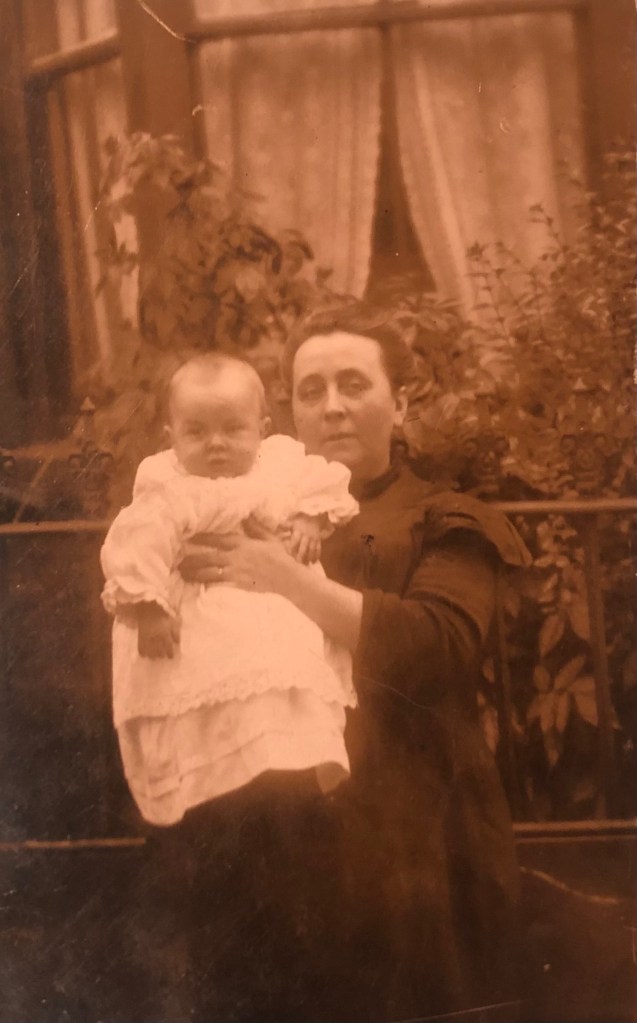
Image: My grandfather Stanley Lucas as a baby with his maternal grandmother, Ellen Johnston (née Stanley). After Mary Josephine Lucas died just weeks after giving birth, Ellen, mourning the loss of her 22 year old daughter, became a central figure in Stanley’s upbringing.
England’s Industrial North
With many generations of my ancestors living and working in the industrial towns and cities of Northern England, it is not surprising that lung disease appears frequently on death certificates. Bronchitis, pneumonia and tuberculosis were common causes of death.
Pollution, smoke and cotton dust would have been ever-present, and without the vaccines, antibiotics and the medicines we rely on today, contagious diseases spread rapidly.
Life and Death by the Water
The River Mersey played a major part in my family history. Most of my paternal ancestors lived in Liverpool, some joining the family when they moved to this major sea-faring hub from Wales, Scotland, Ireland and the Isle of Man. My maternal ancestors were mostly upriver, living near the Mersey and England’s industrial canal system in places like Runcorn and Manchester.
John Lucas (1832–1906)
Like many of my Lucas ancestors, my 3 x great-grandfather John Lucas spent his working life as a sailmaker in Liverpool. In June 1906, aged seventy-five, he went for what the local newspaper described as his “almost daily custom” — a walk along the river. The article noted that “his eyesight was weak, and he suffered occasionally from dizziness” so he wasn’t in the greatest of health.
Later that day, his body was found floating in the River Mersey and retrieved from the Princes Landing Stage. An inquest could not determine how he entered the water. More than a century later, that mystery remains.
John’s death certificate reads:
“Drowning – how he got into the water, the evidence is not sufficient to show.”
More Victims of Drowning
John Lucas wasn’t the only member of my family whose life ended in the water. As I researched further, I found a surprising number of relatives who died in rivers, oceans and even a mill pool.
My great-grandfather James Frederick Edwards was only four years old when his older brother, Matthew Edwards, drowned at sea when the schooner Alma sank after leaving Dublin. Matthew was only fourteen years old when the vessel went down. All six souls on board were lost, including the captain’s wife and her ten-year-old nephew.
John Rutter, another of my 3 x great-grandfathers, died by way of water at his workplace. He was 34 years old, and his wife Elizabeth, a busy housewife and mother, was pregnant with my 2 x great-grandfather George. John was a miller at Oulton Mill in Cheshire, and the story passed down through the Rutter family was that he drowned in the mill pool. His cause of death recorded on his death certificate was:
“Fever of the Brain”
When a second cousin, who had researched the Rutters in great depth, looked up that old medical term, she found that the modern equivalent is highly likely to be meningitis.
There are more still. When I look at my Hornby line, I find two male relatives who died at sea in tragic circumstances and another fourteen-year-old victim of the water: Sarah Hornby, who fell into the River Mersey.
Lifestyle Habits
When I look through the spreadsheet I have detailing the deaths of my direct ancestors, two deaths in particular stand out.
Emma Lucas (née Paisley) (1862–1908)
The first was that of my 2 x great-grandmother, Emma Lucas (née Paisley), who died on 11 November 1908. Her death was subject to an inquest, and the cause was recorded as:
“Extravasation of blood on the brain due to injury to head by accidentally falling on the 9th, accelerated by excessive drinking.”
Excessive drinking! Those words certainly caught my attention.
A second cousin I connected with during my family history journey remembers her mother, one of Emma’s granddaughters, speaking about Emma’s death. According to family lore, Emma had fallen on the steps after visiting the outside toilet. She returned to bed, and the following morning her husband, Joseph, told their daughters not to disturb her while they were getting ready for work. They should let her sleep.
It seems that a few of the women in the street regularly gathered to share a jug of ale. Emma was just 46 years old. Far too young.
George Paisley (1830–1878)
Continuing my research into the Paisley family, I ordered the death certificate of Emma’s father, George, who had died 30 years earlier at the age of 48.
His death was also subject to an inquest.
George died in the Liverpool Workhouse. His occupation was recorded on various census records and his death certificate as a shipwright or ship’s carpenter.
I was staggered when I read his cause of death:
“Inflammation of the spine from injury, 5 weeks, from accidentally falling down stairs whilst intoxicated.”
Intoxicated!
Warning!
What lessons do I take from all this?
Firstly, I’m grateful to live in the age of modern medicine and better public health awareness. Many of the illnesses and conditions that claimed the lives of our ancestors are now treatable or preventable.
Secondly, while many families need to be aware of inherited health risks such as heart disease or cancer, those of us descended from this particular Lucas and Paisley line might need to exercise extreme caution around staircases after enjoying an alcoholic beverage or two.
On that note … cheers!

Note: This article was also published in the Liverpool Family Historian – Liverpool and South West Lancashire Family History Society – June 2025

 Your Family Stories
Leave a comment